
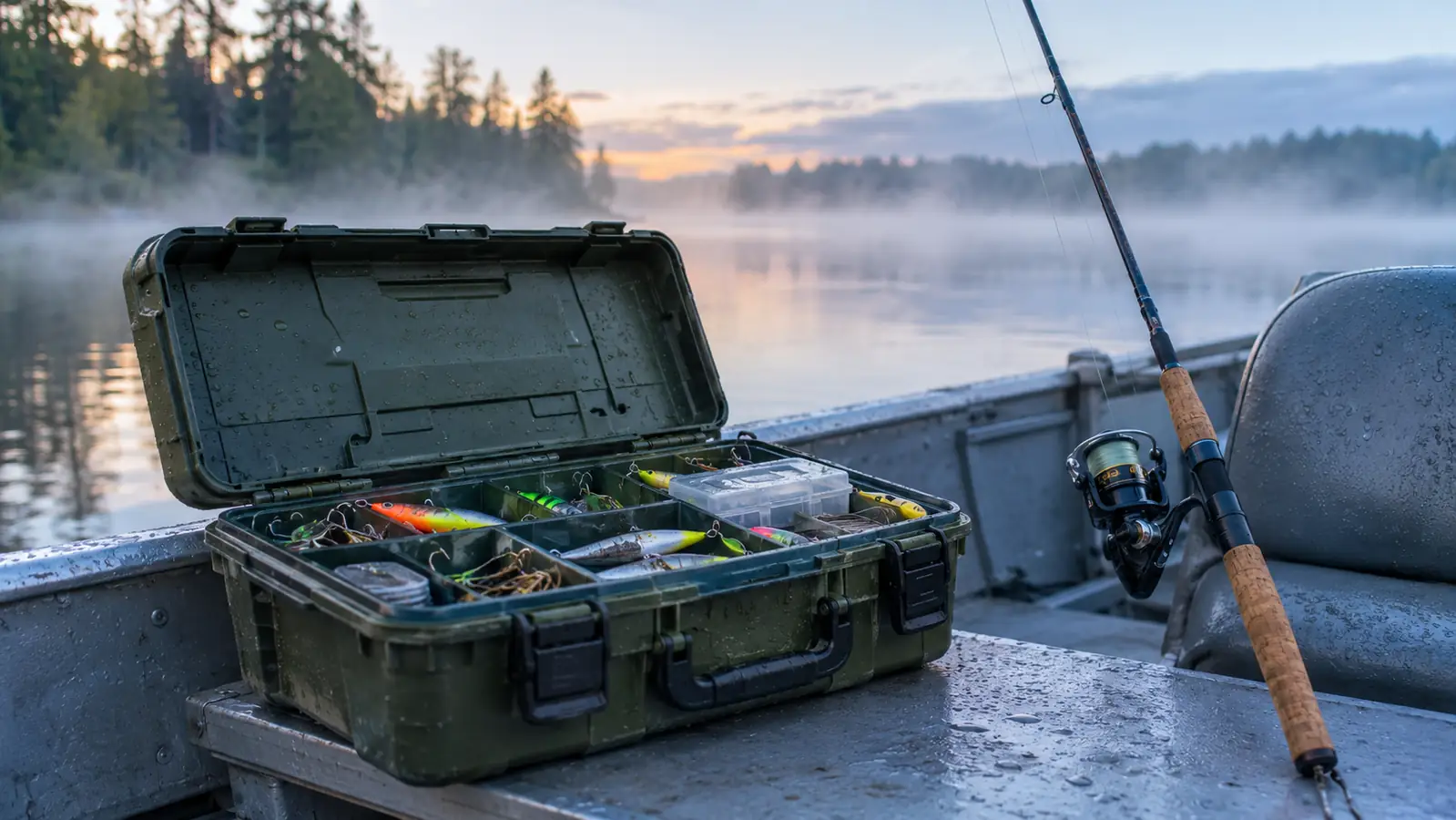
For about ten years my tackle lived in a soft canvas bag that zipped shut on a good day and dumped itself on a bad one. I would get to the river, lean the rod against the truck, and spend the first ten minutes of a two hour evening digging for one pack of hooks. That is a dumb way to fish. Last spring I swapped the bag for the Plano Angled Tackle System, the hard-sided box that comes with three Stowaway utility boxes inside, and I have run it through a full season since. Trout on the small rivers, bass and walleye on the lakes, bank trips and boat trips both.
Here is the short version before the long one. The Plano does one thing most tackle storage does not: it holds the trays at an angle so you can see what is in them without hauling them out. That sounds like a small thing until you have fumbled in low light for a hook while your line drifts into a snag. It is not a small thing. The rest of the box is ordinary and solid, and I will get to the parts that annoyed me.
The Quick Verdict
A plain, hard-working box that keeps three Stowaway trays visible and reachable. It will not organize your fishing for you, but it ends the digging.
Amazon Check Today's Price →Ten Minutes of Digging Is Ten Minutes Not Fishing
The Plano Angled Tackle System holds three Stowaway boxes at a 15 degree angle so you can see what you are reaching for before you reach. Check today's price and current availability.
Amazon Check Today's Price on Amazon →How I've Used It
The box rides in the back of my pickup under a folded moving blanket, which is less about protecting it and more about not hearing it slide around every time I take a corner. It measures 18 inches long, 9.5 inches wide and 11 inches high, and the listing puts it at 7 pounds. That is the empty weight. Load three trays with hooks, jigs, crankbaits and a pair of pliers and it is heavier, though still a one-hand carry from the truck to the water. The utility pocket on the outside is where the license holder and the small pliers live, and it has kept both dry through a couple of soggy mornings.
Spring is small-river trout for me, and that means wading. The second Saturday in April I was on a gravel bar north of Spokane by seven, water still cold enough that I wore the thick socks, and the box went down on the flattest rock I could find with the lid open. I broke off twice in the first hour, both times on the same sunken log, and both times I walked back to the box and had a new hook tied in under a minute. Before, that meant unzipping a bag and pulling out three trays to find the one I wanted, then stacking them back in the wrong order and doing it again twenty minutes later. Now the three trays sit tilted toward me and I can see the row of small spinners and the split shot without touching anything. The trips are the same length they always were. I just spend less of them kneeling on rocks.
Summer is the 14 foot aluminum boat with the small outboard, and that is where the box earns its keep. It slides under the bench seat and stays there. Carol comes along on the calm evenings with a book and no interest in my lure selection, and Jake has been out with me a few times when he can get away. Neither of them wants to hear me rattling through trays. With the lid up and the trays angled, I can pull one lure, tie it on, and go back to watching the line. On a walleye evening in July I changed jig colors four times in about an hour because the light was going and the fish were fussy, and I never once moved my feet out of position.
Off season it comes inside. Sometime in December I spread an old sheet on the shop bench, pulled all three trays, sorted out the rusted hooks, and wiped the compartments down with a rag, with a little oil on the pliers and the file. That job used to be a two hour fight with a canvas bag that had swallowed a loose treble hook back in September. This time it was maybe forty minutes, mostly because everything came out of the box in the order it went in and could go back the same way. In January the box sat on a shelf in the shop with the lid closed, and nothing in it moved until March.
What the 15 Degree Angle Actually Does
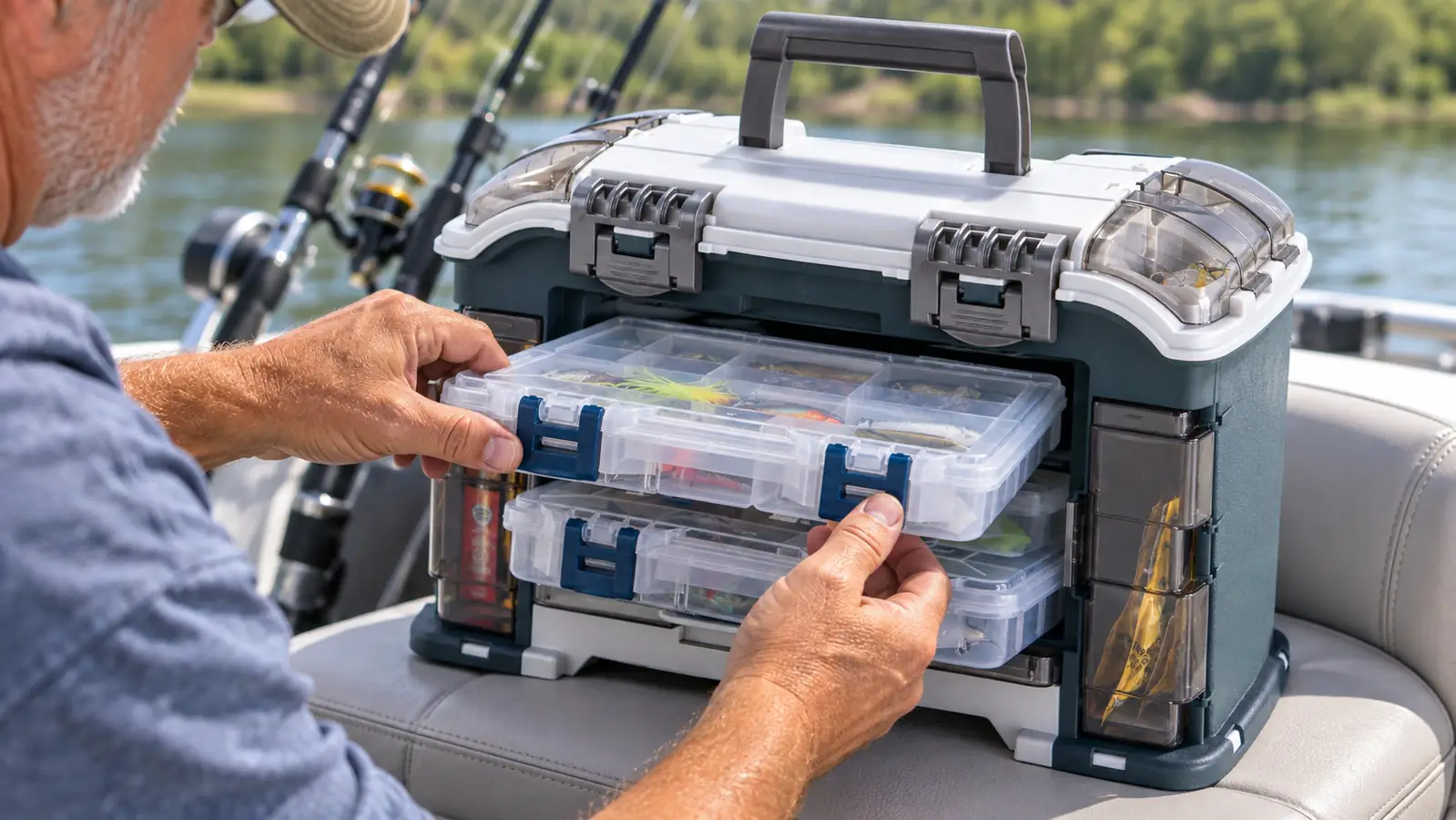
The main compartment presents the utility boxes at a 15 degree angle. That is the whole design idea, and it is worth understanding before you buy, because it only works when the box is sitting reasonably level. The trays are tilted up toward the opening, so the contents face you instead of lying flat at the bottom of a well. You look down and you see compartments, not lids. In a flat box you are looking at the tops of three trays and lifting each one to find out what is underneath it.
On the boat bench it works exactly as advertised. On a sloped gravel bar it works less well, because the whole box tilts and the angle stacks on top of the slope, which means the front tray tips far enough that small split shot can creep forward in their compartments. I had that happen once, in May, and spent a while picking number six split shot out of gravel. I solved it by setting the box on the flattest rock I can find and keeping the lid closed when I am not actively in it. A minute of choosing my spot beats a season of spilled hooks.
The other thing the angle does is make it obvious when a tray is not seated all the way down. In a flat box you find that out when the lid will not shut. Here you see the tray sitting proud of the others and you fix it before you close anything. Small courtesy, but it is the kind of thing you notice after the third time you would have jammed a lid down on a crooked tray. It also means I can reach in with one hand while the other hand is still holding a rod, which happens more than you would think when the fish are on and the light is almost gone.
The Three Stowaway Boxes, and How I Split Them Up
You get three 3560 Stowaway boxes with the system. I split mine by trip type rather than by lure category, because I rarely chase two species in one evening. The first tray is trout: small spinners, a few spoons, split shot, hooks, and a couple of floats. It is the tray that comes out of the box most often, and it is the one that stays in the front slot where the angle shows it best.
The second tray is bass and walleye: jigs, plastic trailers, a handful of crankbaits. The third is the one I almost never open, which is the point. Swivels, extra hooks, spare leaders, a small file, the things you want once a trip and do not want to search for. Having a tray I do not have to touch is the quiet benefit of a three box system. It means the two trays I do use stay organized instead of turning into a pile.
Before this I ran a flat two tray box with a canvas bag on top of it, which is a combination that sounds organized and is not. The flat box had no room for the bag's contents, so the bag carried the overflow, and the overflow was whatever I had not put away the last time out. Twice last spring I drove to the river without the tray that had my trout spinners in it, because it had migrated to the bag and the bag was sitting on the workbench. The angled layout fixed that by making every tray visible at a glance before I leave the driveway. If the front slot is empty, I can see it from the tailgate.
DuraView Covers, Dust, and Rain
The covers and doors are DuraView, which means you can see through them. This matters more than I expected. I can glance at the closed box and tell whether the trout tray is where it should be without opening anything. Over a season the clear panels picked up scuffs and a dull haze from riding in a truck bed, and after enough trips you are looking through them rather than at them. They still work. They just stop being showroom clear, which is true of anything that lives outdoors.
Dust is the bigger issue. Gravel roads in eastern Washington put a fine grit into everything, and a hard box with clear panels is no exception. I wipe the trays out every few weeks and that is enough. Rain is a different matter. This is not a waterproof box, so an open box in a drizzle means wet trays, and wet hooks rust. If the weather is turning, the lid goes down.
There was a stretch in June with three straight days of drizzle and I fished two of them anyway. I kept the box closed, opened it only long enough to pull the one tray I needed, and shut it again. The trays stayed dry enough that I did not have to change hooks the next morning. The lesson is not that the box is waterproof, because it is not and the listing does not claim it is. The lesson is that a hard box you can shut is a lot better in weather than a canvas bag that soaks up a drizzle and holds the damp against your hooks all week.
Three trays tilted toward you at 15 degrees means you see the hook you want instead of emptying the box to find it.
Size and Weight in a Small Boat
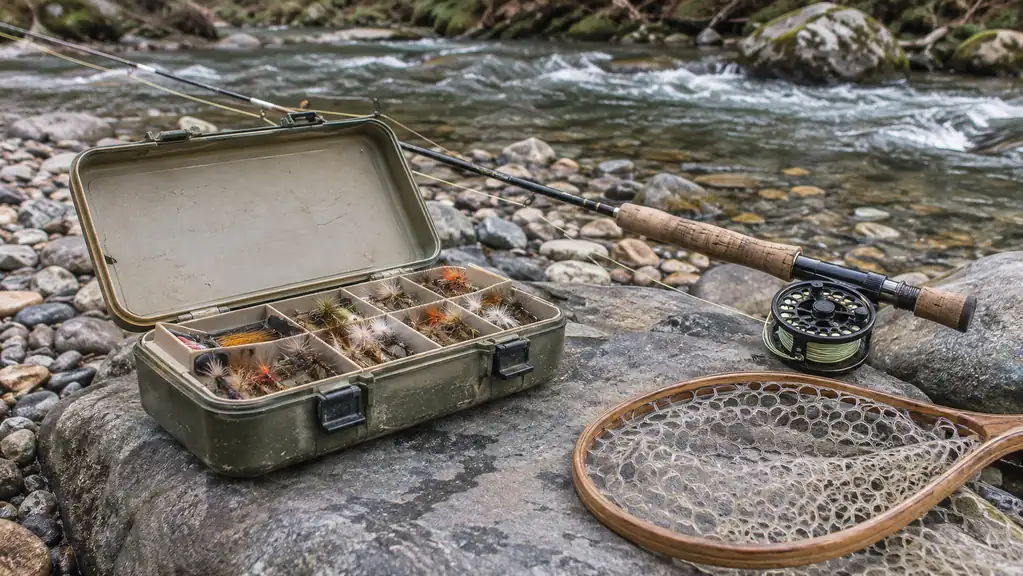
At 18 by 9.5 by 11 inches, this is not a pocket box and it is not pretending to be. In the aluminum boat it fits under the bench and out of the way. In the truck it takes up a corner of the bed and stays there all season. On a walk-in bank trip it is a box you carry in one hand and set down once, not something you sling over a shoulder and forget about. Carrying it a hundred yards from the truck to the water is nothing. Carrying it half a mile is a different conversation entirely.
There are no wheels on it, so it is a carry it or leave it in the truck kind of box. That is fine for how I fish, and it is worth being honest about for how you fish. If your trips start with a quarter mile walk through brush to a cut bank, this will feel like a small cooler by the time you get there. Two of my best spring spots are exactly that kind of walk, and on those days I pull the trout tray out, leave the box in the truck, and carry the tray in a small daypack. That works, but it is worth knowing going in that you may end up doing it too.
What Held Up Over a Season
The shell is hard, and after a full season of riding in a truck bed, getting set down on gravel, and being stepped over in a boat, nothing cracked. The doors and covers still open and close the way they did in April. The trays have not warped, even after a few July afternoons when the inside of the truck was hotter than the outside air. The lid still closes flush, which is the thing I expected to go first. I went into this expecting to like the layout and doubt the hardware. It has been the other way around: the hardware is boring and fine, and the layout is the part I would miss.
If you are weighing this against a plain utility style box, I laid out the differences in a separate comparison, and the short of it is that you are paying for the angled main compartment and the three trays that come with it. What you give up is packability. The other tradeoff nobody mentions is that a fixed layout is a fixed layout. The Stowaway compartments are what they are, so if you carry a lot of one oversize lure, it goes in loose or it does not go. I have one oversized crankbait that has lived in the truck console since May for exactly that reason.
What I Liked
- Three 3560 Stowaway boxes included, so the box is usable the day it arrives
- The 15 degree angle keeps trays visible and reachable instead of buried
- DuraView covers let you check contents without opening the lid
- Hard shell shrugs off a truck bed and a boat bench without cracking
- 18 x 9.5 x 11 inches slides under a 14 foot boat bench and stays out of the way
- Utility pocket keeps a license holder and small tools separate from the trays
Where It Falls Short
- Not waterproof, so an open box in rain means wet trays and wet hooks
- 7 pounds empty and noticeably heavier loaded, which is a real carry on walk-in trips
- No wheels, so it is a truck box more than a hiking box
- The angle only helps when the box sits level, and gravel bars are not level
- Fixed Stowaway compartments will not swallow an oversize lure
Who This Is For
This is for the angler who fishes from a boat or drives to the bank and carries more terminal tackle than fits in a pocket. If you chase two or three species across a season and you are tired of unpacking trays to find one hook, the angled layout does real work for you. It also suits anyone whose gear lives in a vehicle. The hard shell and clear covers mean the box can sit in the truck between trips without you wondering what is happening inside it, and the trays come out in the order you put them in.
Who Should Skip It
Skip it if you walk in a long way, if you fish from a kayak, or if your whole kit is one small tray of jigs and a pair of pliers. A box this size is a burden when you are covering ground, and the angle buys you nothing if you only carry six lures. Also skip it if you fish in the rain and refuse to close a lid, because this box will not save you from that. For everyone else, the honest summary is simple. I have carried cheaper boxes and I have carried bigger ones. This is the first one that stopped me from digging.
One Season In, I'd Buy It Again
Three Stowaway trays, a 15 degree angled main compartment, and a hard shell that survived a truck bed and a boat bench. Check today's price and availability on the Plano Angled Tackle System.
Amazon See Today's Price on Amazon →