

The bite turns on for about twenty minutes in the evening, and that is exactly when you end up on your knees in a fourteen foot aluminum boat, digging through a tackle box that has turned into a nest of treble hooks and tangled line. It happened to me last July on a lake north of Spokane. My son Jake was working a crankbait along the weed edge and catching fish, and I spent most of a good evening separating two crankbaits that had married each other in a compartment I thought was organized. Nothing was missing from that box. Everything was just mixed together, and mixed together is worse than missing.
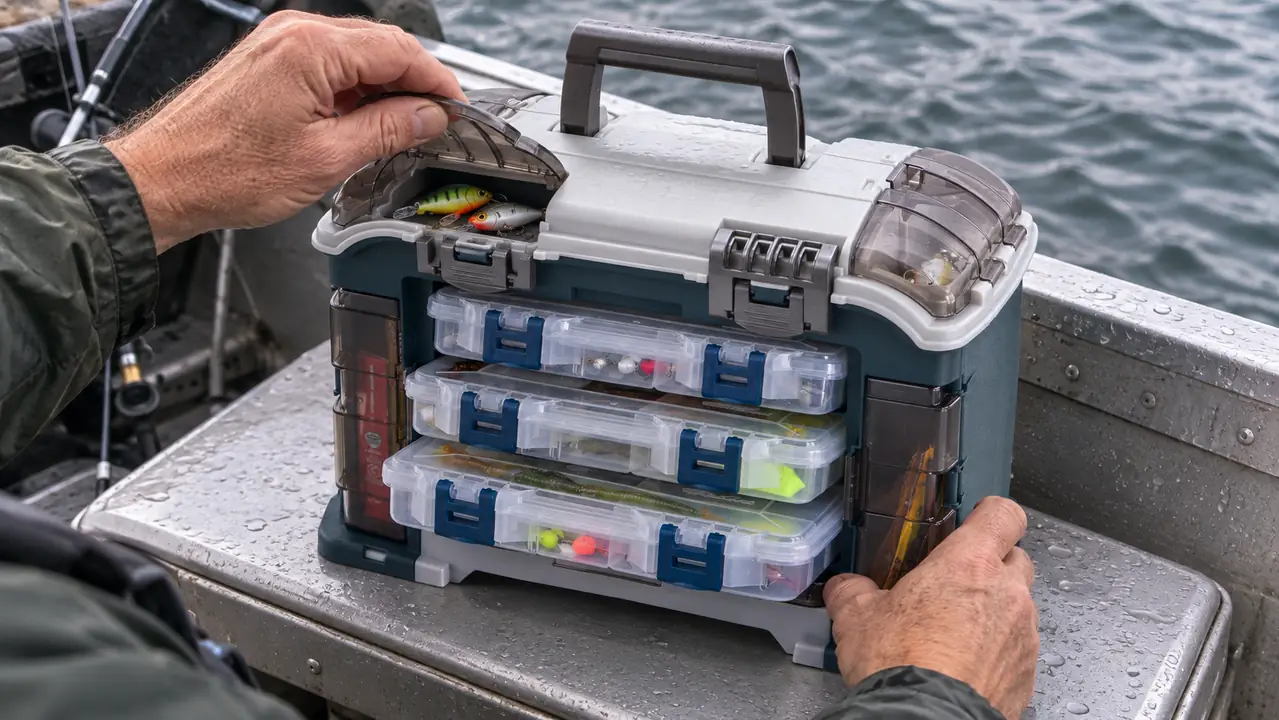
Organizing a tackle box for boat fishing is a different job than organizing one for the bank or the garage. On a boat you have one hand free, your feet are not planted, and the box is open in front of you for maybe ninety seconds at a time before you need to make a cast. The Plano Angled Tackle System is built around that reality. The main compartment holds three Stowaway utility boxes tilted at a 15 degree angle toward you, so you look down into the compartments instead of pulling a box out and setting it somewhere that is already holding a net. The shell measures 18 inches long, 9.5 inches wide and 11 inches tall, about 7 pounds empty. That is the whole design. The rest of the job is how you load it.
A box that shows you what is in it while the boat is still moving
Three Stowaway trays held at a 15 degree angle inside a hard shell, so you can read a compartment and take one lure out without unloading the tray onto a wet deck.
Amazon Check Today's Price on Amazon →Step 1: Decide what actually lives on the boat
The mistake I made for years was treating the tackle box as the place where all my tackle lives. It is not. It is the place where today's tackle lives. Everything else stays home in a plastic tote, and that tote comes out the night before a trip, not on the water with the wind pushing you toward the rocks.
Start by dumping the boat box on a bench. Then ask one question about each item: have I tied this on, from this boat, in the last two seasons? If the answer is no, it goes into the garage tote. Not thrown out, just moved. I keep two exceptions, a big swimbait for the one lake that grows big fish and a pouch of heavy jigs for the spring river, because the trips where I need them are long drives and a wasted morning if those baits are sitting on a shelf at home.
Three trays is the limit with the Plano system, and the limit is the useful part. Three trays means three categories and a list short enough that you learn it by feel in the dark. When I had nine boxes in the boat I was always grabbing the wrong one, because nine categories is not a system, it is a pile with dividers. Three is a decision.
Step 2: Sort by what you throw, not by what you own
The most common way to sort a box is by lure type. All the crankbaits together, all the spinnerbaits together, all the jigs together. It looks beautiful in the garage and it falls apart on the water, because you are never standing in a boat thinking that you would like a crankbait. You are thinking that the walleye are sitting on that break in eighteen feet of water and you need something that gets down to them.
So sort by technique and by depth instead. In my boat box the three Stowaway trays break down like this. Tray one is trout, small spinners, a few spoons, hooks and split shot for the rivers. Tray two is bass and walleye, crankbaits, a couple of jigs, soft plastics. Tray three is the repair tray, leader line, spare hooks, a hook file, and the small items I need to fix a rig instead of tying on a new one. The repair tray earns its place every trip, usually inside the first hour.
If you fish one species, this gets easier. Split that species by shallow and deep, or by morning and midday, and give the third tray to terminal tackle. The habit of sorting by the decision you make on the water matters more than the labels you write on tape.
Step 3: Load each tray as a complete kit
A Stowaway box is not a drawer. It is a kit, and a kit should let you finish a job without opening anything else. That means a few hooks in the same compartment as the plastics you will rig them on. A swivel in with the leader material. A spare treble in with the crankbait it belongs to, so you are not doing two searches for one repair.
This is where most boxes turn into a mess. People buy a hundred hooks, put all hundred in one compartment, and then spend the season opening that compartment looking for one size. Put eight hooks in the boat tray and leave the other ninety two home. The tray is a working set, not inventory. Rummaging is what inventory costs you, and you pay it at the worst possible time.
Load with the angle in mind. Heavier items sit low in the compartment, soft plastics go where they will not get crushed under a lead weight, and nothing sticks up tall enough to hold a lid open. A lid that will not close flat is how a tray of hooks ends up rusty after a rain shower on a boat seat, and I have thrown away more tackle that way than I have lost in snags.
Step 4: Load it so you can read it without lifting it out
On a fourteen foot aluminum boat there is no flat space that is not already holding something. The middle seat has the net on it. The floor is wet. The front deck is where your feet go when a fish runs around the bow. You do not have a place to set a box down and sort through it, which is exactly why so many boat boxes end up open on a seat with the contents sliding around.
The Plano system answers that with the tilt and with the DuraView covers and doors on the trays. The boxes sit angled toward you in the main compartment, so you can look straight down into the compartments from a seated position without lifting a tray out. The covers let you see a section before you open it, which sounds like a small convenience until you try to find one specific spoon in the last twenty minutes of light.
Load for that sightline. The lures you throw most go in the compartments nearest the front edge, where your hand lands first. The things you dig for, spare hooks and odd weights, go toward the back. Turn every bait so the hooks are not pointing at the next compartment. Treble hooks will find each other through a divider if you let them, and once two crankbaits are hooked together you will cut line to get them apart, and you will do it while the fish are still biting.
Step 5: Cut weight and decide where the box rides
The empty box weighs about 7 pounds. Loaded, mine runs closer to fifteen, and I know that because a loaded box sliding across an aluminum floor tells you it is heavy. Pull the third tray on trips where you will only throw two things. Leaving a tray in the truck costs you nothing. Carrying it all day costs you balance, and balance is what keeps you out of the water when a wake rolls under a small hull.
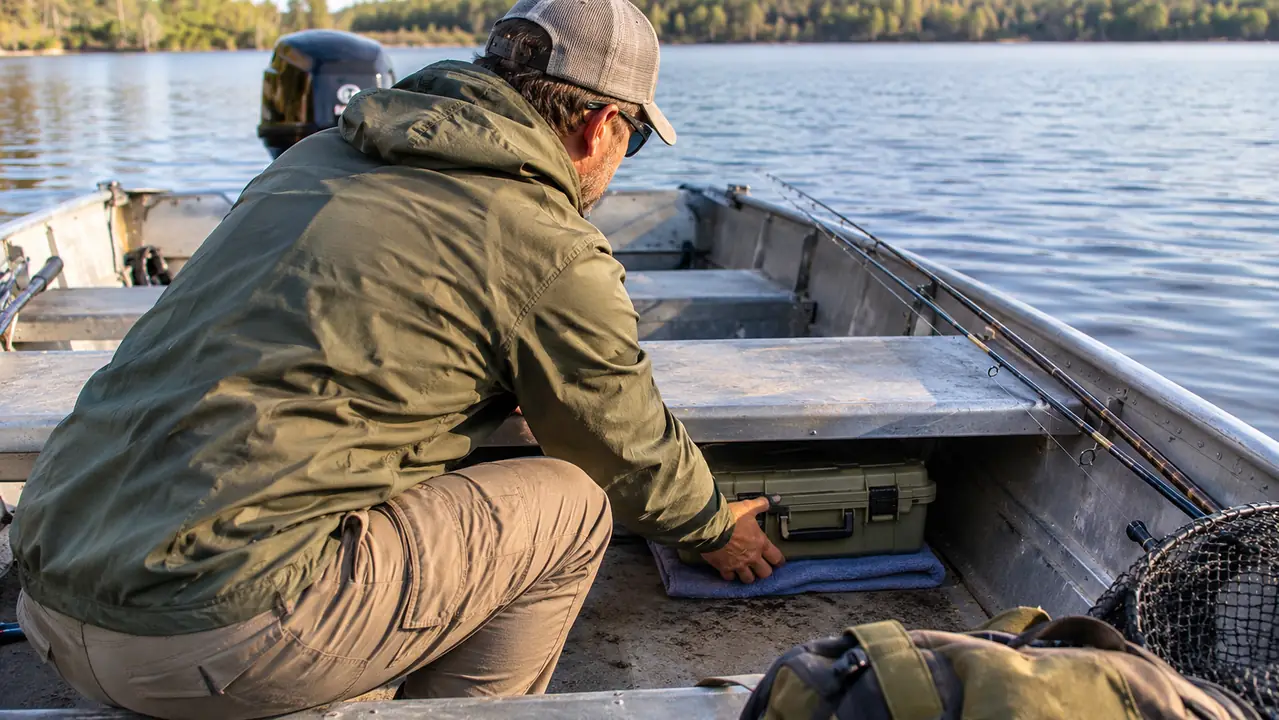
Stow it where it cannot move. Mine rides under the middle seat, wedged against the hull with a folded towel under it. The towel is not for the box. It is for the noise. A hard shell on an aluminum hull makes a sound like a dropped toolbox every time a boat wake hits you, and on a quiet morning that sound ends the fishing in that cove for an hour.
The utility pocket on the outside is where the loose items go, truck keys, a lighter, the registration card in a bag. It keeps them out of the trays where they end up buried under a pile of plastics. Small thing. It saves five minutes of patting pockets at the ramp every single trip.
One honest note: this box has no wheels and it is not light. If you are carrying it a quarter mile from the truck to a bank spot, you will feel it in your shoulder. That is why mine lives on the boat and a smaller box goes in the truck for bank trips. It is a boat box, and it is good at being one.
What Else Helps
The box is one part of the system. Three small habits do more for a boat day than any new lure you could put in it.
Keep your pliers and line cutters on a lanyard. If they live loose in a compartment you will knock them overboard in the first hour, and then you will spend the rest of the trip trying to bite through twenty pound line. Keep a towel clipped where you can reach it from the seat, so your hands are dry before they go into a tray of hooks. Keep a small container for used soft plastics, because the ones you peel off a jig end up in the bottom of the boat and then in the lake.
A cheap dry bag for the phone and the registration is worth more than it costs, and so is a second towel that stays dry. Wet gear put away wet is how reels start to grind by August. If something comes back to the ramp soaked, it comes out of the boat at home and sits on the bench overnight, not in the tray.
And do the reload at home, not at the ramp. The twenty minutes you spend the night before a trip, putting the trays back the way they were and pulling out the lures you tried and did not use, is the difference between a box that works all season and a box you reorganize in July with a pile of tackle spread across a bench. The Plano trays are small enough that the reload takes twenty minutes. That is the real reason the three tray limit works for me. It is a system I will actually keep up with, and a system you keep up with beats a better system you do not.
A hard shell on an aluminum hull sounds like a dropped toolbox every time a wake hits. On a quiet morning, that sound ends the fishing in that cove.
Load it once, then stop thinking about it
Three Stowaway trays held at a 15 degree angle inside a hard shell that measures 18 by 9.5 by 11 inches and weighs about 7 pounds empty. That is a working box, not a storage unit.
Amazon Check Today's Price on Amazon →