
Here is the short answer before I get into the weeds. For the fishing I actually do, KastKing Superpower braid in 20 pound test is the line that ends up on most of my reels. It casts farther, it tells me what is happening at the end of the line, and one spool lasts me more than a season. Monofilament still has a job in my boat, and I still keep a spool of it under the seat, but it is no longer the line I reach for first. Braid is the better tool for most days, and mono is the better tool for a few specific ones.
I fish rivers and lakes around Spokane, mostly from the bank or from a 14 foot aluminum boat with a small outboard. Trout on the small rivers, bass and walleye on the lakes, spring through fall. That means rock, sunken timber, wind, and water that runs cold in April and turns to bathwater by August. A line that behaves across all of it is worth more to me than a line that wins on a machine in a warehouse. So this is not a spec sheet comparison. It is what I noticed after fishing both lines side by side through a full season, and which one I would spend my own money on again.
| KastKing Superpower Braid | Monofilament | |
|---|---|---|
| Bite detection | Zero stretch, so a light tap on a jig comes straight up the line | Stretch swallows part of the feel, worst in deep water |
| Hookset on plastics | No give, so a short snap drives the hook home | Soft, you have to sweep harder to move the hook |
| Diameter for strength | Small diameter, so a modest reel holds plenty of 20 pound line | Thicker at the same strength, eats spool capacity |
| Rock and timber | Abrasion resistant braid scuffs and keeps going | Nicks turn into the weak spot you find out about later |
| Treble hook lures | Almost no give, so a hard head shake can throw hooks | Stretch holds tension on trebles all the way to the net |
| Knots | Needs extra wraps, a wet cinch, and no rushing | Forgiving, a simple clinch holds fine in the dark |
| Cost to fill a spool | More up front, but it stays on the reel for seasons | Least expensive per yard, easy to replace often |
| Time on the spool | Does not take a set or break down in sunlight | Memory and UV damage, replace at least once a season |
| Rod guides | Can wear a grooved tip top over a couple of seasons | Soft on guides and tip tops |
| Best for | Jigs, plastics, deep water, windy days | Crankbaits, topwater, kids and loaner rods |
How I Compared Them
I spooled one medium baitcaster with 20 pound KastKing Superpower and one spinning reel with 12 pound monofilament on the second weekend of April, the first Saturday the boat ramp was clear of ice. Same lakes, same river stretches, plenty of days when both rods were in the boat and I alternated casts. I did not baby either line. Both sat in a hot truck bed, both got rained on, both got dragged over rock and through timber, and neither got respooled until the season ended. The mono was ready to come off by the middle of July. The braid was not.
What I paid attention to was the boring stuff. How many taps I felt before I saw the line twitch. How the line came off the spool after a month of sitting in the sun. How many fish I lost at the boat. How often I had to cut back and retie because a rock had chewed the last two feet. None of that shows up on a spec sheet, and all of it decides whether you enjoy your day or spend it retying in the wind.
Two things I did not test, because I cannot. I am not going to tell you one line is stronger than another based on a knot pull in my garage. And I am not going to pretend I can feel the difference between brands at 20 pound test on a windy lake. The one bench test I did run was dragging a scrap of each line over the same rough edge ten times with a hook sharpener, and even that told me less than a single morning on the water did. What I can tell you is what held up and what did not over four months of real fishing, and where each line made my day easier.
Where KastKing Superpower Braid Wins
The first thing you notice is the feel. Superpower has zero stretch, and that changes how a jig fishes. On a windy day, with a quarter ounce jig dragging over gravel in 18 feet of water, mono gives you a soft mush at the rod tip. Braid gives you a tick. There was a Tuesday in June with a north wind pushing the boat sideways and I put four walleye in the livewell in under an hour on that jig, and I do not believe I would have felt a single one of those taps through mono. I catch more fish on soft plastics in deep water with braid for the simple reason that I know when to set the hook instead of guessing and hoping. That is not a small edge. It is most of the game.
Second is diameter. Twenty pound braid is thin, thin enough that a small spinning reel holds noticeably more line than it would with 20 pound mono. That matters when a fish makes a long run and you are watching the spool empty. It also matters in wind, because a thinner line catches less air, which means fewer loops and fewer tangles coming off the reel at the worst possible moment.
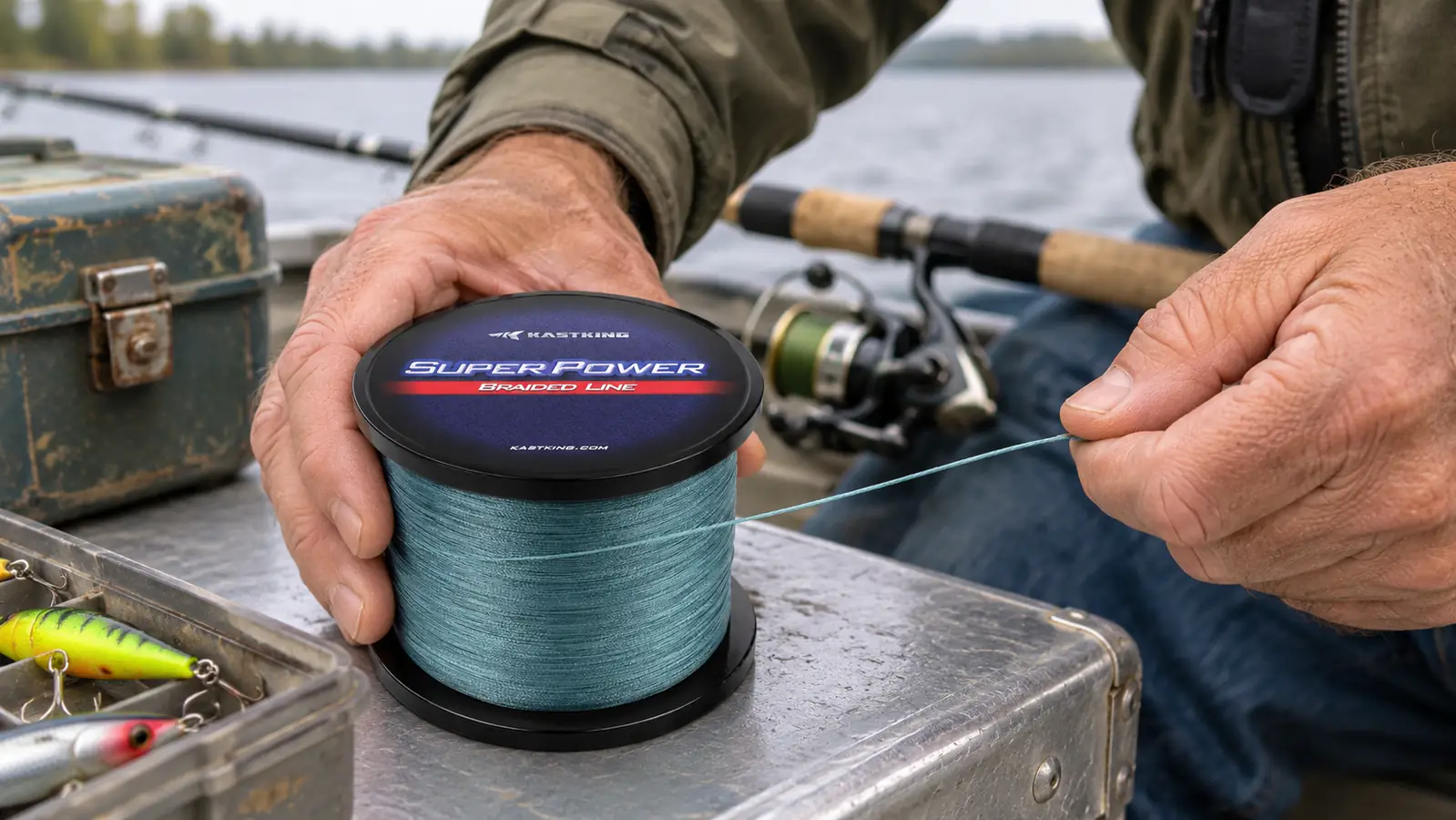
Third is how long it lasts. Monofilament is a sponge for sunlight and heat. Leave a spool on a reel in the garage all summer and it comes off coiled like a spring. Braid does not do that. I have had the same KastKing Superpower on one baitcaster for two seasons and it still lays flat and still casts the same distance it did the first week. The listing carries a lifetime warranty, which tells you what the company thinks about its own shelf life.
Fourth is abrasion. The line is a multi-strand polyester braid, and it takes a scrape on rock better than mono does. On one stretch of the Spokane River I fish, broken basalt is everywhere. Mono gets a nick and I find out about it on the next hookset. Braid scuffs and keeps going. I still run my fingers up the last three feet after every snag, out of habit, but I am not finding the same damage I used to find with mono.
Where Monofilament Wins
Now the other side, and it is a real side. Monofilament stretches, and for treble hook lures that stretch is a good thing. A crankbait with three hooks on it, a bass shaking its head at the boat, a topwater bait getting slapped and thrown. Mono keeps tension on those hooks the whole way in. Braid does not give at all, and a hard head shake on a short line will pull hooks out of a fish's mouth. I learned that the hard way in August, thirty feet from the boat, on a squarebill I had tied straight to braid with no leader. The fish came up, shook once, and the bait came back without it. I have not fished a crankbait on bare braid since.
Knots are the second thing. I can tie an improved clinch in mono half asleep in the dark. It cinches down, it holds, and I trust it. Braid needs more wraps, needs to be wet, and needs to be snugged down hard or it will slip on you. I have lost fish to a braid knot that looked fine coming off the spool. I have never lost one to a mono knot that looked fine.
Third is cost and convenience. Mono is the less expensive line to fill a spool with, and it is the line you can replace once a month without thinking twice about it. It is also softer on rod guides. A cheaper rod with a grooved tip top will wear braid over a couple of seasons. Mono will not touch it.
Fourth, and this one matters more than people admit, mono is forgiving when things go wrong. You can break it off. Twenty pound braid will bend a hook out or pull a knot loose before it breaks, and if you are bank fishing with no boat, you do not want to be standing there with a lure stuck in a log 40 feet out and no way to get it back.
Two seasons on the same spool and it still lays flat and still casts the same distance. Monofilament does not survive a hot garage in Spokane that way.
If you want to feel the bite instead of guessing at it, spool up the 20 pound Superpower
300 yards covers a baitcaster with plenty left over for a spinning reel. Zero stretch, small diameter for its strength, and a lifetime warranty from KastKing.
Amazon Check Today's Price on Amazon →
What 20 Pound Test Actually Means
Twenty pound test does not mean the line is as thick as 20 pound mono. Braid is small in diameter for its strength, and that is the entire point of it. A spinning reel that holds a modest amount of 8 pound mono will hold a lot more 20 pound braid. That is why so many bass and walleye fishermen run braid on reels that look too small for the job, and why their casts go farther than yours did.
The other thing to know is that 20 pound braid is not overkill for bass and walleye. You can pull a lure through weeds, you can turn a fish away from a dock, and you can do it with a line thin enough to still cast well. If you are used to 10 or 12 pound mono, going to 20 pound braid will not cost you casting distance. It will probably gain you some.
One practical note. If you fill a spool with the whole 300 yards and only ever fish 40 yards of it, you are wasting line. Put a cheap mono backing on first, then top with braid. You get the casting and feel benefits where they actually matter, and you do not burn a fresh spool doing it. The 300 yard spool gives you room to do that without running short.
Do You Still Need a Leader
Most of the time, yes. My setup is simple. Twenty pound KastKing Superpower on the reel, then four to six feet of monofilament leader tied on with a double uni knot. Eight pound leader on the trout rods, twelve on the bass rods, fifteen if I am fishing around timber. I started at three feet and went longer after watching fish shy off a jig in clear water in late summer. Six feet still casts clean through the guides if you are not trying to bomb it, and the extra length is what keeps the braid itself out of the fish's line of sight.
The leader does two jobs. It gives a little stretch at the business end, which saves me on treble hooks and on fish that roll at the net. It also gives me something to sacrifice. I would rather break off six inches of eight pound mono than cut back a braid main line I have been fishing for two seasons. Check the leader after every fish and after every snag. If it feels rough between your fingers, retie it. That habit is worth more than any brand choice on this page.
Who Should Buy Which
Buy the KastKing Superpower braid if you fish soft plastics, jigs, drop shots, or Texas rigs, or anything where the bite is subtle and the water is deep. Buy it if you fish in wind. Buy it if you are tired of respooling every spring. Buy it if you have a spinning reel that never seems to hold enough line, or a baitcaster that backlashes every time the line takes a set in cold weather.
Stay with monofilament if your fishing revolves around crankbaits, jerkbaits, and topwater. Stay with it if you are spooling a rod for a kid, a guest, or a loaner. Stay with it if your rod has cheap guides, or if you fish water where you hang up constantly and need to break off clean without leaving hardware in the lake.
Most of us end up with both in the boat, and that is the honest answer. Braid is the better line for the fishing I do most. Mono is the better line for the fishing I do some. Knowing which is which is the whole trick, and it beats buying a new rod to solve a problem that was never about the rod in the first place.
One spool, 300 yards, and a season of not thinking about your line
Twenty pound Superpower braid, available in nine colors, small diameter and zero stretch. Pair it with a short mono leader and it handles nearly everything I fish around here.
Amazon Check Today's Price on Amazon →