
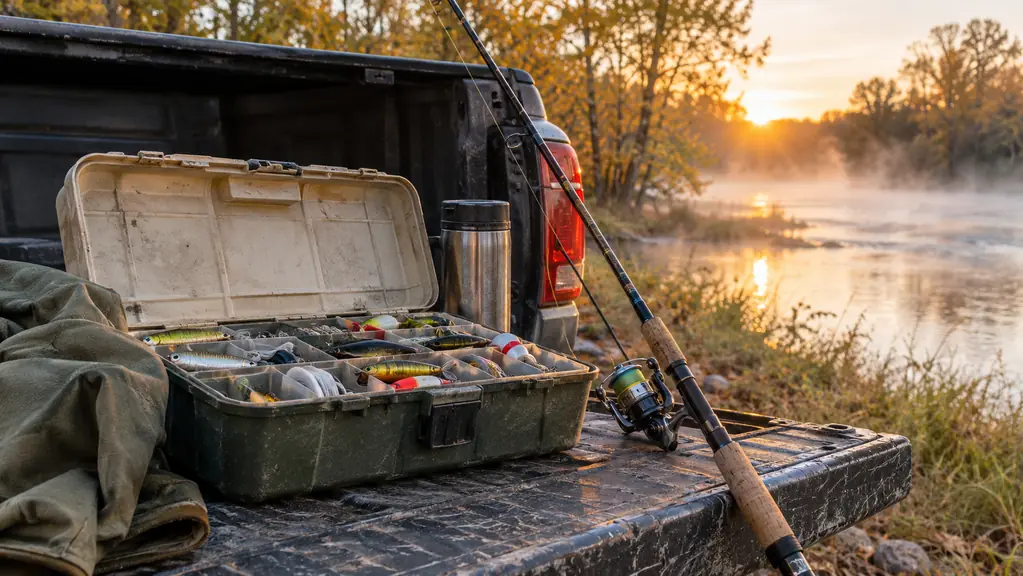
There's a version of this review where the Plano Angled Tackle System changed my life on the water. That version would be a lie, and you'd catch it by the second paragraph. Here's what actually happened. I loaded this box into the truck, carried it to the bank and into a 14-foot aluminum boat, and fished out of it for two full seasons. Nothing cracked. Nothing warped. Nothing rusted shut. About a month in, I stopped thinking about it at all, which is the highest thing I can say about a tackle box. The honest part is what it costs you in weight, and how that changes where you're willing to take it.
Start with the number that never makes the headline: seven pounds, empty. That's the listed weight on the Plano 728001 and it's close to what it feels like sitting on your tailgate with nothing in it. Fill the three boxes with jigs, crankbaits, hooks and a couple of spools and you're past twelve. On a boat, that number doesn't matter. On a quarter-mile walk in to a river bend, it matters a great deal. That is the trade this box makes, and once you know it, you can decide in about ten seconds whether it's your trade.
The Quick Verdict
A hard-shell boat box with an honest angle and an honest weight. Buy it for a seat to set it behind, not for a long walk in.
Amazon Check Today's Price →The 15 degree tilt is real. So are the seven pounds.
If the box lives behind a boat seat or on a tailgate from spring to fall, this one earns its place. Check the current listing and the three included Stowaway boxes before you commit.
Amazon Check Today's Price on Amazon →How I've Used It
I'm a maintenance supervisor at a water treatment plant outside Spokane, so my fishing comes in evenings and weekends. Spring into early summer that means trout on the small rivers. From July on it's bass and walleye on the lakes, mostly out of the 14-foot aluminum boat. The box lives in my truck from April to October. It rides behind the middle seat, comes out at the ramp, sits open on the gunwale while I tie on a lure, and goes back in the truck at dark.
Two seasons of that is a fair test, and I did not baby it. It's been rained on, dropped off a tailgate, and had a full thermos set on the lid. I have not had a single failure that cost me fishing time. My son Jake borrows it when he takes his kayak out, which tells you how much gear it swallows, and he's also the one who pointed out that it weighs more than he wants to paddle around with.
One evening sticks with me as the whole argument in miniature. Third week of September, last light going, I was drifting a crawler along a weed edge on the lake and losing baits to a snag I couldn't see. Twelve casts, twelve hang-ups, and I was down to my last two crawler harnesses. I pulled the boat onto the sand, carried the Plano up the bank, set it flat on a cooler lid, and had the walleye box open and both harnesses replaced in under a minute. With my old soft bag that same fix takes five, because everything's migrated to the bottom and you're digging past two hundred hooks to find what you want. That's the whole case for this box. Not that it's clever. That it doesn't slow you down when the light is going and you're out of patience.
I still keep a soft bag for walk-in trips. That isn't a knock on this box, it's just how I split the job now. The Plano stays with the boat and the truck. If I'm hiking in to a beaver pond or a bend I can't drive to, the soft bag goes and the hard box stays home. Two pieces of gear for two different jobs, and I quit trying to make one do both.
The 15 Degree Angle: What It Actually Does
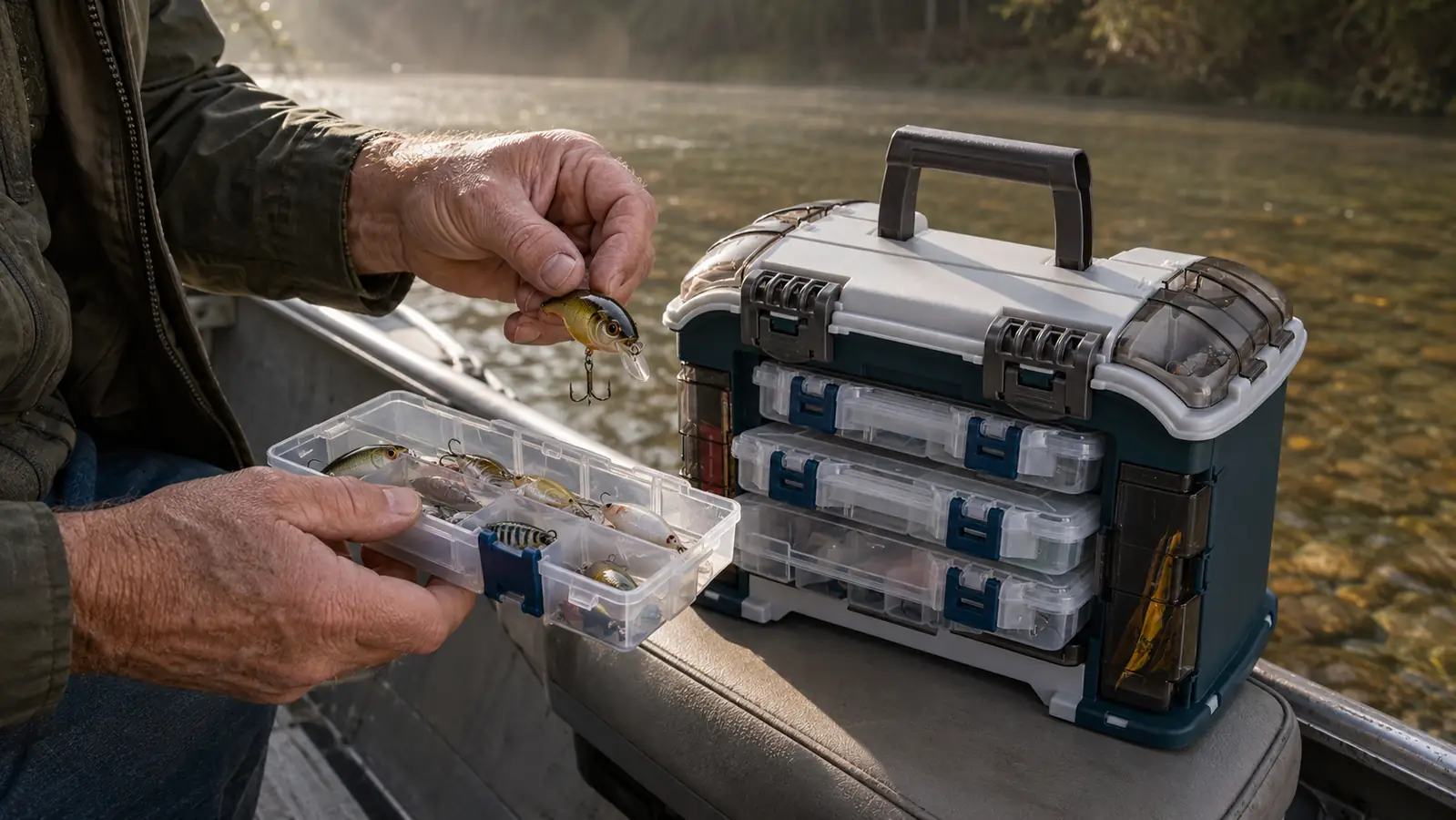
The main compartment holds the boxes at a 15 degree angle, and the first time you flip the lid it looks like a sales gimmick. It isn't, once you're standing over it. A flat box forces you to tilt your head or lift the tray out to see the back row. At 15 degrees you look straight down and the whole tray reads front to back in one glance. When the fish are short-striking and you're swapping crankbaits every eight casts, that saves real seconds, and those seconds add up over an evening.
Here's what nobody tells you about it. The angle only pays off when the box is sitting flat on something. On a boat seat, a tailgate, or the floor of a drift boat, it's fine. Wedged on a sloping bank with the box in your hand, everything slides to the low end and the advantage disappears. The tilt is a workbench feature, not a walking-around feature.
It also means the lid has to come up and back before you can get a finger under a tray. That's nothing at the ramp. It's clumsy when you're standing in waist-deep water with the box on the bank behind you, which is the single most common way I fish a river in June.
The angle takes up real room in the truck, too, and that surprised me. The box stands 11 inches tall on its own, and because the lid swings up and back you need closer to two feet of clear space above it before you can get into a tray without fighting the lid. I learned that the hard way in June of the first season. I had it slid under the back bench of the truck bed, thinking I'd saved space, and the first time I opened it the lid hit the bench and stopped halfway. I couldn't reach the back row of the bass box at all. I had to pull the whole thing out, set it on the tailgate, and do my swap there. Since then it rides on the passenger floorboard where the lid has room, or behind the middle seat with nothing stacked on top of it. Small thing to know before you buy. If your truck bed is packed with coolers and camp chairs by mid-summer, plan on this box needing its own spot.
Seven Pounds Empty Is the Whole Argument
The box measures 18 inches long, 9.5 wide, and 11 tall. It has a hard shell and it weighs seven pounds before anything goes in it. Set it next to a soft bag and it is not a close contest. You feel the difference in your hand on the first carry and in your shoulder on the fourth.
What that weight buys you is a shell that doesn't fold, a lid that doesn't sag, and trays that don't turn into a tackle salad when the truck hits a pothole. I've had soft bags end up a nest of treble hooks by August, with two lures married together and a hook buried in the canvas. This box has never done that. The structure is the product.
The other half of it: no wheels. The spec sheet says it plainly and I'll say it plainly too. This is a box you carry by hand from the truck to the water and that's the end of it. If your walk in is half a mile through sagebrush, you're carrying seven pounds plus lures plus water, and by the second trip you'll leave it in the truck and stuff your pockets instead. That isn't a defect in the build. It's a design that assumes you have a seat or a tailgate to set it on.
I weighed mine on the shop scale out of curiosity, loaded the way I actually fish it. Bass box with eight jigs and three packs of plastics, trout box with a dozen spinners and a couple of stickbaits, walleye box with harnesses and weights, plus pliers and clippers in the pocket. Twelve and a half pounds. Then I loaded my soft bag the same way, all the same gear, and it came in at just under six. That's the entire honest comparison, six against twelve and a half, for the same pile of tackle. I walked both of them a measured quarter mile up the gravel bar below the bridge one Sunday morning just to settle it in my head. The soft bag went up that bar once. The Plano went up it twice and then stayed in the truck for the rest of the morning while I made trips back for it. If you do the math on six and a half pounds over a mile of walking, that's not a small thing.
What the Three Boxes Will and Won't Hold
It comes with three Stowaway utility boxes, sized to the 3560 series named in the title, and the compartment holds exactly those three. Not four. Don't plan on cramming a spare in, because the tilt means there's no slack in there.
Three boxes is enough for how I fish. One for trout: small spinners, a couple of stickbaits, hooks, split shot. One for bass: jigs, a few packs of plastics, a chatterbait or two. One for the walleye gear and the spare terminal tackle. If you throw big swimbaits or musky-sized baits, understand now that this isn't your system. Nothing about it is built for baits much over five inches, and forcing them in makes the whole tray sit crooked.
The DuraView covers are the quiet win. You can see what's in a box without popping it open, so you check the trout box from three feet away, confirm you've got the ones you want, and put it back. Small thing. Over a season it's a lot of small things, and it's the feature I'd miss most if it were gone.
The utility pocket is where my pliers, line clippers and license holder live. That's how it should work. The stuff you grab with wet hands stays out of the trays and out of the way. It's sized for hand tools, so don't expect it to swallow a scale or a spare spool.
Compartment depth is the other limit worth naming. The boxes sit maybe an inch and a half deep in the trays, which is fine for jigs, spinners and terminal tackle and fine for plastics laid flat. It is not fine for a deep-diving crankbait with a long bill, and it is not fine for a buzzbait with a skirt. Those want to ride on top and then the lid won't quite close. My first month I tried to make the bass box hold everything I owned. It held about two thirds, sat proud in the tray, and I spent a Saturday wondering why the lid seemed stiff. It wasn't stiff. It was resting on a spinnerbait blade. I pulled the big baits out, put them in a soft bag in the truck, and the box has closed flush ever since.
Rain, River Spray, and Two Seasons of Truck Bed
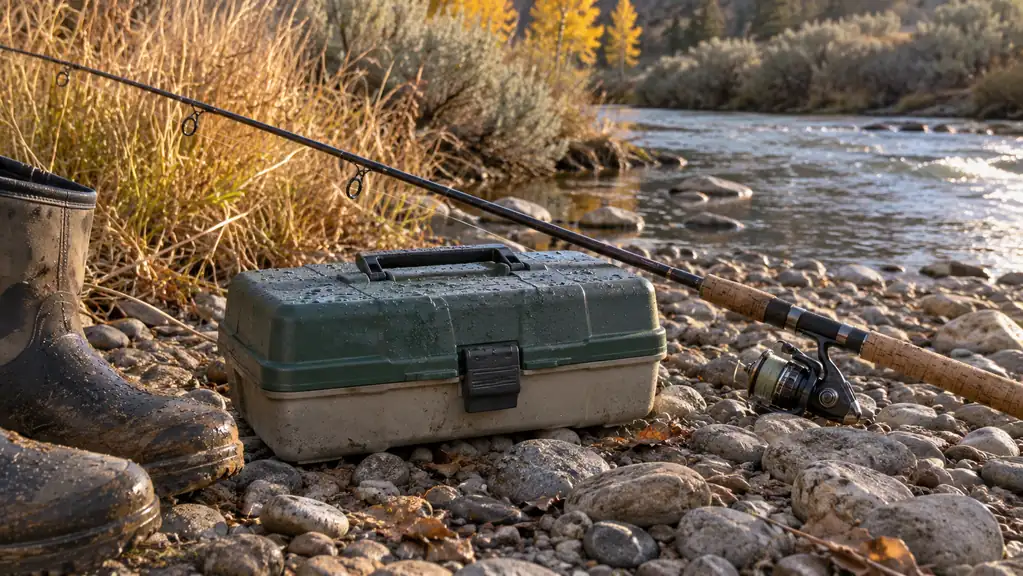
The box has been rained on hard enough to puddle in the lid, and the boxes inside stayed dry. The covers and doors seat well. After two seasons the hinge area is still tight and nothing has cracked, including the corner it landed on when I dropped it in the dark on a boat ramp in October.
It is not waterproof and it doesn't claim to be. Set it in an inch of water in the bottom of a boat, which I have done more than once, and water finds its way in around the lid. Nothing drowned. One box of hooks picked up a light film of rust by the end of the second season, and I'll own that as much as the box does, because I left it wet in the truck for a week.
The drop is worth describing, since it's the only real abuse that ever scared me. Boat ramp at the lake launch, second week of October, about 5:40 in the morning and full dark. I had the box under one arm with my rod in the other hand, stepped onto that wet concrete, and went down more than I fell. The box hit corner first from about three feet and slid. I figured that was the end of it. I got a light on it and there's a scuff on that corner the size of a thumbnail, and the lid still seats and the trays still slide out clean. It survived something my last two soft bags would not have. The shoulder took a month, but the box was fine.
Hard shell. One utility pocket. No wheels. That's the entire inventory. There's nothing electronic, nothing that needs a battery, nothing that can fail in a way you can't see coming. Gear that is simple is gear you keep, and this is the kind of box I expect to still be loading in ten years.
What I Liked
- Lid opens to a 15 degree tilt, so the whole tray reads at a glance without lifting a box out
- DuraView covers let you see the contents before you open anything
- Hard shell has survived two seasons of tailgates and boat ramps without a crack
- 18 by 9.5 by 11 inches tucks behind a boat seat or under a truck bench
- Utility pocket keeps pliers, clippers and a license out of the trays
Where It Falls Short
- Seven pounds empty, which is heavy for any kind of walk-in trip
- No wheels, so it moves by hand only
- Holds exactly the three included boxes and nothing more
- The tilt means the lid has to come fully open before you can pull a box
- Not waterproof when it sits in standing water
- Needs about two feet of clear space above it to open the lid without fighting it
Twelve and a half pounds loaded, six for the soft bag with the same gear. I walked both up that gravel bar to settle it, and the soft bag went up once.
Who This Is For
This box is for the angler who fishes from a seat most of the time. A boat, a dock, a tailgate, a cooler lid at the ramp. If your gear lives in a truck from opening day to freeze-up and you want to see every lure you own without unpacking anything, this does that job better than a soft bag does.
It's also for the person who is tired of replacing bags. A soft bag is cheaper and it will last a couple of seasons if you're kind to it. The Plano is heavier on day one and still doing the same job on day seven hundred. If you want to buy once and stop thinking about tackle storage, this is a reasonable place to stop looking.
Who Should Skip It
Skip it if you walk in. Sagebrush flats, canyon breaks, a mile of river you can only reach on foot. Seven pounds empty turns into twelve loaded, and twelve pounds on a sling is a different afternoon. Get a soft bag and put the saved effort into more casts.
Skip it too if you throw big baits or carry more than three trays of gear. The compartment is sized for the three boxes that come with it, and the tilt doesn't leave room to argue. And skip it if you fish from a kayak or a float tube, because there's no good place to set a hard box down and no way to make the angle work in your lap.
If it rides behind a seat from April to October, this is the one.
Three Stowaway boxes, a hard shell, and a 15 degree tilt that earns its keep on a boat seat. Check the current price and the exact dimensions before you buy.
Amazon Check Today's Price on Amazon →