
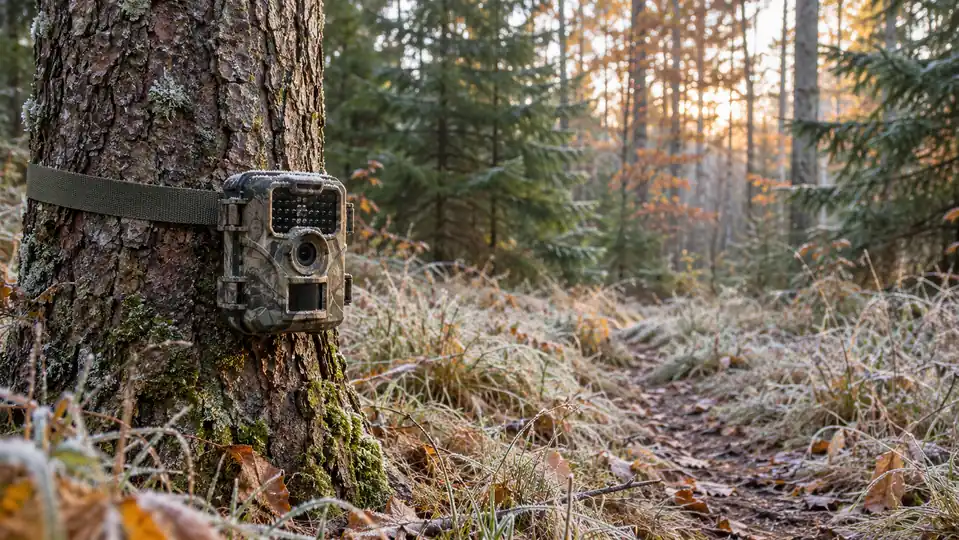
I hung the WOSPORTS Mini Trail Camera on a hemlock above a rub line in the second week of September and did not touch it again until the last weekend of November. Three months of eastern Washington weather. Two hard frosts, a week of steady rain, one night that dropped eight inches of snow, and a windstorm that took down a dead pine forty feet away. When I finally walked back in, the card had more than eleven hundred files on it and the camera was still taking pictures.
I hunt public land. That means I walk in from the truck, I cannot bait, and I don't get to decide where the deer go. What I need from a camera is simple. It powers on, it triggers when something moves, and it survives the cold. That's the whole job. The WOSPORTS is a small battery-powered box that does that job most of the time, and it gave me less grief than the two cameras it replaced. It also has a couple of habits that will bother some people, and I'll get to those.
The Quick Verdict
A compact, push-button, card-pull camera that ran a full fall season without quitting. Daytime stills are good enough to age a buck on. Night video is weak and the 850nm IR puts out a visible red glow, but for scouting a trail it does the job.
Amazon Check Today's Price →The one I left in the woods for three months and got back still shooting
No phone pairing, no account, no wireless to babysit. Batteries, a card, and a tree. That's the whole setup.
Amazon Check Today's Price on Amazon →How I've Used It
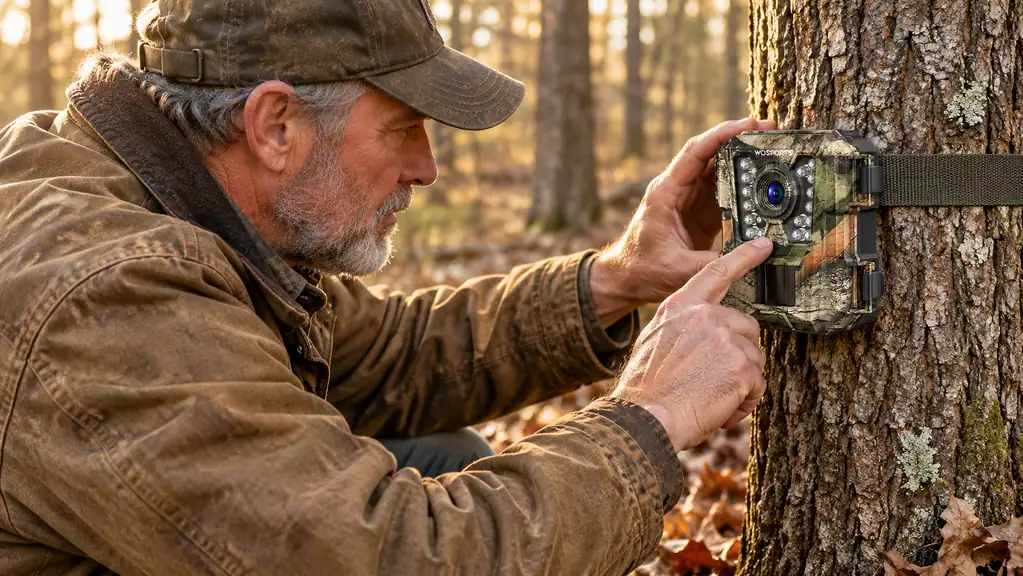
Setup took about ten minutes in the driveway and most of that was learning the button sequence. This is a push-button camera. No touchscreen, no phone pairing, no account to create. You press through the menu, set the date and time, pick photo or video, and hang it. That's the entire interface, and I mean that as a compliment. I have owned cameras that wanted my email address before they would photograph a raccoon.
I did the first setup on a Saturday morning in September, in the driveway, with a cup of coffee and the folded instruction sheet on the tailgate. You press the button to wake the screen and press through to the date and time. I got the date wrong on the first pass because I hurried it and had to walk back through the menu, which is the one thing about this camera that will test your patience. The second unit took me four minutes from battery door to strap. No phone, no pairing, no account, no update prompt. My last camera wanted an email address and a confirmation link before it would take a picture of a deer. I am fifty-eight years old and I do not have that kind of patience at seven in the morning in November.
It runs on battery power and it writes to an SD card. That's the power and the storage, full stop. No solar panel to aim every trip, no external pack to strap on, no cable running down the tree. I put a card in, closed the housing, strapped it to the hemlock, and left it alone until November.
Placement turned out to matter more than any setting on the camera. My first hang was chest high on a trunk facing slightly downhill, and I came back to a card full of empty frames. The PIR sensor is sensitive and it was catching a branch that moved every time the wind picked up. I dropped the camera to about four feet, angled it down toward the trail, and cut the brush out in front of it. The empty frames mostly stopped after that. That's not a knock on the camera. It's the same lesson every camera teaches you the first time.
What 30MP Stills and 1080P Video Actually Get You
The camera shoots 30MP photos and 1080P video. I'll be straight with you, megapixels on a trail camera are like horsepower on a work truck. The number on the box is not the thing that decides whether the truck pulls. What matters is whether I can tell a three-year-old from a two-year-old at forty yards in a still frame. In daylight with this camera, I can. I counted points from the base up on a forkhorn and could see where he'd broken one off.
The video is where I got the most value out of it. A still frame tells you what walked past. Video tells you what it did. I have one file that ran the better part of nine minutes, a forkhorn working a scrape, and it showed me which direction he came in from and which way he left. That's scouting, not inventory. The tradeoff is file size. Leave it set on video for three weeks and you'll be pulling the card more often than you want to.
Here is the actual math from my season. Two cameras, four card pulls, and the hemlock unit alone put a little over eleven hundred files on the cards. If I had to guess, four hundred of those were moving brush and the back end of a squirrel. Sorting that takes two evenings on the laptop at the kitchen table, and nobody warns you about that part. The video files are what fill a card, so for the last two weeks of October, when I expected the most traffic, I set the hemlock camera to stills only. That was the right call. I got the same information out of a fraction of the files and spent an hour on it instead of three. The WOSPORTS makes that switch in the menu with a few button presses, and it holds the setting when you power it down, which is more than I can say for the camera this one replaced.
The body measures 4.25 by 4.21 by 3.43 inches and weighs 11.68 ounces. On public land that isn't a spec sheet detail, it's the reason I can hang it where I want to. A compact body sits flat against the trunk instead of hanging off it like a mailbox, and it doesn't catch the eye of the next guy walking the ridge above you.
Night Vision, and What 850nm Means in the Field
Night is where inexpensive cameras usually fall apart, and this one is honest about its limits if you read the specs closely. It uses 850 nanometer infrared, which means it puts out a visible red glow when it fires. On a fence post behind the barn, nobody cares. On public land, a red light blinking on a tree is a signal to every other hunter who walks past. You should know that going in, because the listing won't spell it out for you.
The black and white night photos are usable out to roughly thirty feet on an animal standing broadside. Past that, or on anything moving, you get grain and smear. I got a raccoon at about fifteen feet that is crisp enough to count toes on. I got a deer at forty feet at a trot that is a grey shape with legs under it. That is the honest tradeoff at this size and this class of camera.
I checked the night range myself one evening in the middle of October, walking off the distance ten feet at a time and standing still at each mark while the camera fired. At fifteen feet the frame was clean enough to read the seams on my jacket sleeve. At thirty feet I could tell it was a person and not much more. At forty-five it was a shape against the brush. That curve matched what I got on animals all season, so I stopped guessing about it and just hung the camera where the trail pinched down to fifteen or twenty feet. The IR emitter throws a faint red glow you can pick up from maybe twenty yards in real dark if you are looking straight at it. A deer does not seem to care. Another hunter will.
For my purposes it's fine. I want to know what is using the trail after dark and roughly what time it came through. I'm not trying to age a buck off a long-range night frame. If that's your goal, this isn't the camera for it and I'd rather tell you now than have you find out in December.
Card Pulls, Weather, and the Housing
Everything lives on the SD card. There is no cellular connection and no wireless of any kind, so the camera cannot send a picture anywhere. You walk in, open the housing, pull the card, drop in a fresh one, close it up, and walk out. I keep a card reader in the truck and go through the files on my laptop at the tailgate. Two cameras, three months, four card pulls. That's the routine and I don't mind it.
The housing is ABS plastic and it's rated water resistant, not waterproof. I read that as a real distinction rather than marketing hedging. It sat through rain and snow and a hard freeze without fogging the lens or taking on water. I would not drop it in the creek, and I would not leave it sitting in a puddle. Hung on a tree the way it's meant to be, it did everything I needed it to do.
Cold is the thing that kills cameras around here. One morning in late October it was nineteen degrees at the trailhead and the camera was still triggering. By the end of the season it had not quit on me once. I've had cameras that ate batteries in a cold snap and went dark in the middle of the rut. This one didn't.
The windstorm was the one I worried about. It came through the last week of October and dropped that dead pine about forty feet uphill from my hemlock. I walked in the following Saturday braced to find the camera in the duff. It was still on the trunk, still shooting, and the strap had not slipped an inch. There was pine pitch smeared on one side of the housing, which took a little solvent to get off, and that was the whole of the damage. I checked the seal around the card door that trip and the inside was dry. That mattered more to me than anything printed on the box. The WOSPORTS does not try to be clever about any of this, and that is exactly why it survived.
Where It Frustrated Me
The button menu is clumsy. Changing one setting means pressing through several steps, and doing that with cold hands in fading light is nobody's idea of a good time. Do your setup in the driveway in good daylight, not kneeling in the snow at the trailhead. I learned that the first week and it saved me a lot of cussing later.
The trigger is sensitive enough that moving brush will set it off, which is how I ended up with a card full of empty frames before I moved the camera. Some of that is fixable with placement and a pair of loppers. Some of it is just the nature of a PIR sensor hung in a windy draw. Plan on cleaning up the field of view before you hang a camera anywhere.
And the night video is the weakest thing on the unit. Stills after dark are usable at close range. Video after dark is mostly a dark rectangle with a suggestion of movement in it. I quit shooting night video after the second card pull and set it to stills only. That's a real limitation and it's the main reason this is a four-star camera instead of a five.
What I Liked
- Compact and light at 4.25 by 4.21 by 3.43 inches and 11.68 ounces, so it sits flat against a trunk
- Push-button setup with no phone, no account and no wireless to fuss with
- 30MP daytime stills are sharp enough to count points and spot a broken antler
- 1080P video shows behavior, not just presence, which is real scouting value
- Ran from September into late November on battery power and triggered at nineteen degrees
- ABS housing rated water resistant handled rain, snow and a hard freeze without fogging
Where It Falls Short
- 850 nanometer IR gives off a visible red glow, which is a consideration on public land
- Night photos get grainy past roughly thirty feet or on anything moving
- PIR sensor is sensitive enough that wind-blown brush sets it off
- No wireless and no cellular, so every check is a walk-in and a card pull
- Button menu is slow to navigate, especially with cold hands
A still frame tells you what walked past. The video told me which direction he came in from and which way he left. That's the difference between knowing a buck exists and knowing how to hunt him.
Who This Is For
This is a good camera for the hunter who walks in from the truck and wants to know what is using a trail, a scrape or a fence crossing without spending a pile of money or babysitting a phone app. If you run two or three cameras on a piece of public ground and you're fine pulling cards every couple of weeks, this fits that routine. It's also a reasonable first camera for someone who has never set one up, because there's almost nothing to break.
It's a good fit for the angler too, believe it or not. I know a couple of guys who hang one on a bank trail to see when the walleye crowd shows up, and one who uses it to watch a creek crossing behind his place. Anywhere you want a small battery-powered box taking pictures on a motion trigger, it does that job. The WOSPORTS is not fancy. It's a tool, and it works like one.
Who Should Skip It
If you want pictures delivered to your phone while you're at work, skip this one. There's no cellular connection and no wireless here, so nothing arrives anywhere except on the card. That kind of camera exists and it costs a lot more, and you should go read about that instead of buying this and being disappointed. I'd rather point you straight.
If you're trying to identify and age bucks off long-range night frames, this will let you down. The night reach is short and the night video is rough. Same story if you want it for security on a gate or a shed, where a visible red glow and a card pull every few days is not what you're after. Buy it for daylight scouting and close-range night confirmation, and you'll be happy with it. Buy it for anything else and you won't.
If a simple camera is all you actually need, this is the one
Hang it, pull the card, hunt the sign. Batteries, a card, a tree, and a season's worth of answers. Nothing else to manage.
Amazon Check Today's Price on Amazon →