
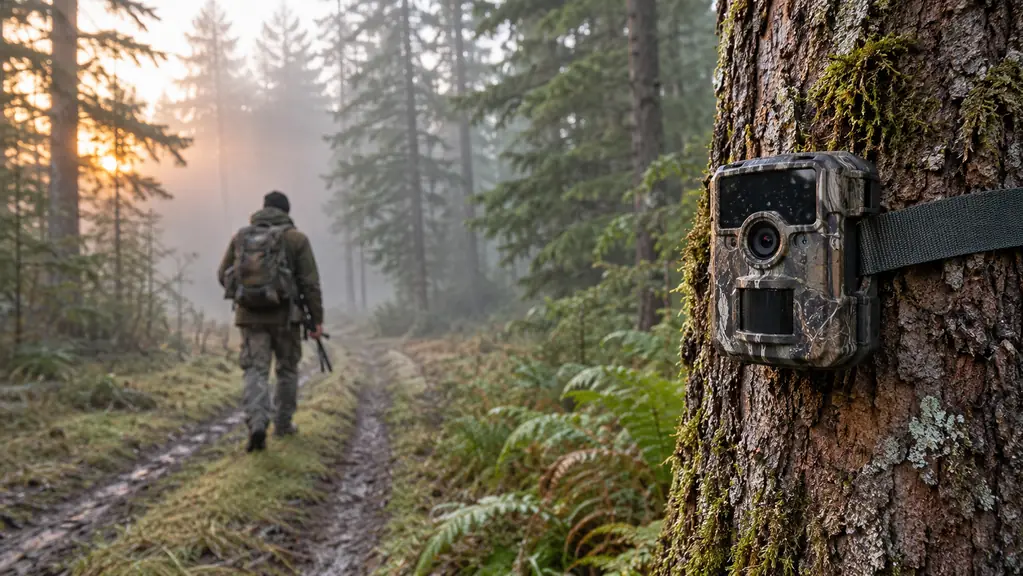
If you are stuck between the WOSPORTS Mini Trail Camera and a cellular trail camera, the decision comes down to one question. Do you need the picture while you are sitting at the kitchen table, or are you willing to walk out and get it? I am Odell Prewitt, 58, and I live outside Spokane, Washington. Most of my deer hunting happens on public land in eastern Washington, a few miles from pavement, with my rifle in my hand and my truck waiting at the gate. I have run the WOSPORTS Mini on a timber edge and on a rubbed-up fence line. I have also borrowed a cellular camera from my son Jake for a season. Both do a job. They do not do the same job.
Short answer: if you check your ground on foot, the WOSPORTS is the simpler tool. It saves 30MP photos and 1080P video to an SD card, runs on battery power, and does not need a signal, an account, or a data plan. A cellular camera sends pictures to your phone, which is a real advantage when you cannot get to the property. The catch is that you are now depending on coverage, a subscription, and a device that has more ways to fail. Neither is wrong. You just have to be honest about how you scout.
| WOSPORTS Mini Trail Camera | Cellular trail camera | |
|---|---|---|
| How you get the photo | Saves 30MP stills and 1080P video to an SD card; you pull the card and review on a laptop | Sends compressed images to a phone over a cell signal |
| Real-time scouting | No remote alert; you learn what walked by when you check the card | Alerts you while you are at home, at work, or in another stand |
| Setup | Push-button controls, SD card, tree or wall mount, no account to create | Needs a SIM, a data plan, signal at the camera, and an app pairing process |
| Signal dependence | Works anywhere you can hang it, no cell coverage needed | Only works where the carrier has coverage |
| Night capture | 850nm infrared night vision with a PIR motion sensor | Infrared night capture, but the image you receive is sent over the network |
| Size and weight | 4.25 by 4.21 by 3.43 inches, 11.68 ounces | Usually larger because of the radio and antenna; exact size varies by model |
| Power | Battery powered, listed at 12 volts and 5 watts | Battery powered, and the radio draws extra power; exact draw varies |
| Weather | Water resistant ABS enclosure | Weather resistance varies by model |
| Ongoing commitment | No data plan, no account, no monthly service | Requires a data plan and an active account to send photos |
| Checking without bumping deer | You have to walk in to get the card | You can check from the road or from home without entering the timber |
| Best for | Public-land hunters who check a few spots on foot and want full files | Hunters who live far from the property or need to watch a spot during the week |
| What you own after the season | The camera and the card; files are yours to keep | The camera, plus an active subscription if you want it to keep sending |
Where WOSPORTS Wins
The WOSPORTS wins the walk-in hunt. That sounds simple, but it matters. On public land, I am already carrying too much. I do not want to stop at a gate and wonder whether my camera has bars. The WOSPORTS does not care about bars. I hang it on a tree, push the buttons to set it, and leave. The 30MP files and 1080P video stay on the SD card until I come back with a laptop. That is the whole system. No account, no data plan, no waiting for a picture to travel through a cell tower that may be two ridges away.
That difference came home to me two Octobers back. I had a camera on a fence post at the edge of a hay field, and I was sure I had a pattern worked out. When I finally walked in to pull the card, the camera had been facing a blown-down alder for three weeks. The wind had shifted it. I had been planning sits around nothing at all. A cellular camera would have told me the view was wrong on day two, but I would have known only because I was watching my phone, and honestly I would not have been. I was at work. That is the gap between the two tools in one sentence: one tells you the camera moved, the other makes you go look.
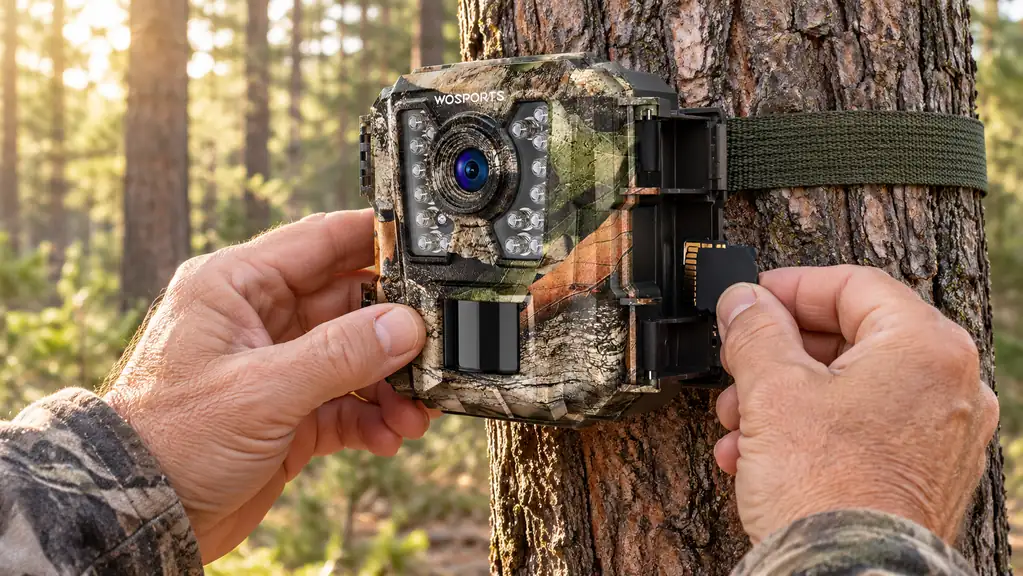
It also wins on size and fuss. The body measures 4.25 by 4.21 by 3.43 inches and weighs 11.68 ounces. I can tuck it in my pack with a spare card and not think about it. The push-button controls are the kind I can work with gloves on, and the tree or wall mount means I am not rigging some special bracket. The ABS enclosure is water resistant, not waterproof, so I still hang it under a limb or a cedar bough. But it has handled wet October mornings without me babying it. For a hunter who checks three or four spots on foot, that is enough.
Where a Cellular Trail Camera Wins
A cellular camera wins when you cannot be there. That is the honest answer. Jake works weekdays and cannot run out to a ridge every afternoon, so a camera that sends a photo to his phone is worth the extra setup to him. He can see a buck working a scrape at 4:30 on a Tuesday while he is still at work. I cannot do that with the WOSPORTS. I get the picture when I walk in. If the wind is wrong or the deer are moving at last light, I may be a week late on the news.
Jake runs his on a piece of river bottom ground, and he learned the hard way to check coverage before he hangs anything. His first spot had one bar and the pictures came in batches, three days behind. He moved the camera forty yards up the slope and got a solid signal. That is the kind of thing you sort out once and then forget about, but it is also the kind of thing that makes a guy leave a camera sitting in the truck. My WOSPORTS has never had that problem, because it has never needed a bar of anything.
The other thing a cellular camera buys you is less intrusion. Every time I walk to a camera, I leave scent and pressure. On a small piece of private ground, or a public spot that gets hunted hard, that matters. A cellular camera lets you check from the road. It also helps when you live an hour or more from your ground and cannot justify a midweek drive. The tradeoff is real: you need coverage where the camera sits, you need to keep the account active, and you need to manage another device. But when it fits, it fits.
The WOSPORTS wins the hunt you can walk to. A cellular camera wins the hunt you cannot get to.
If you check your ground on foot, start with the camera that does not need a signal.
The WOSPORTS Mini saves 30MP photos and 1080P video to an SD card, runs on battery power, and uses push-button controls. No account and no data plan. Hang it, leave it, and pull the card when you come back.
Amazon Check the WOSPORTS Mini on Amazon →The Setup I Actually Run
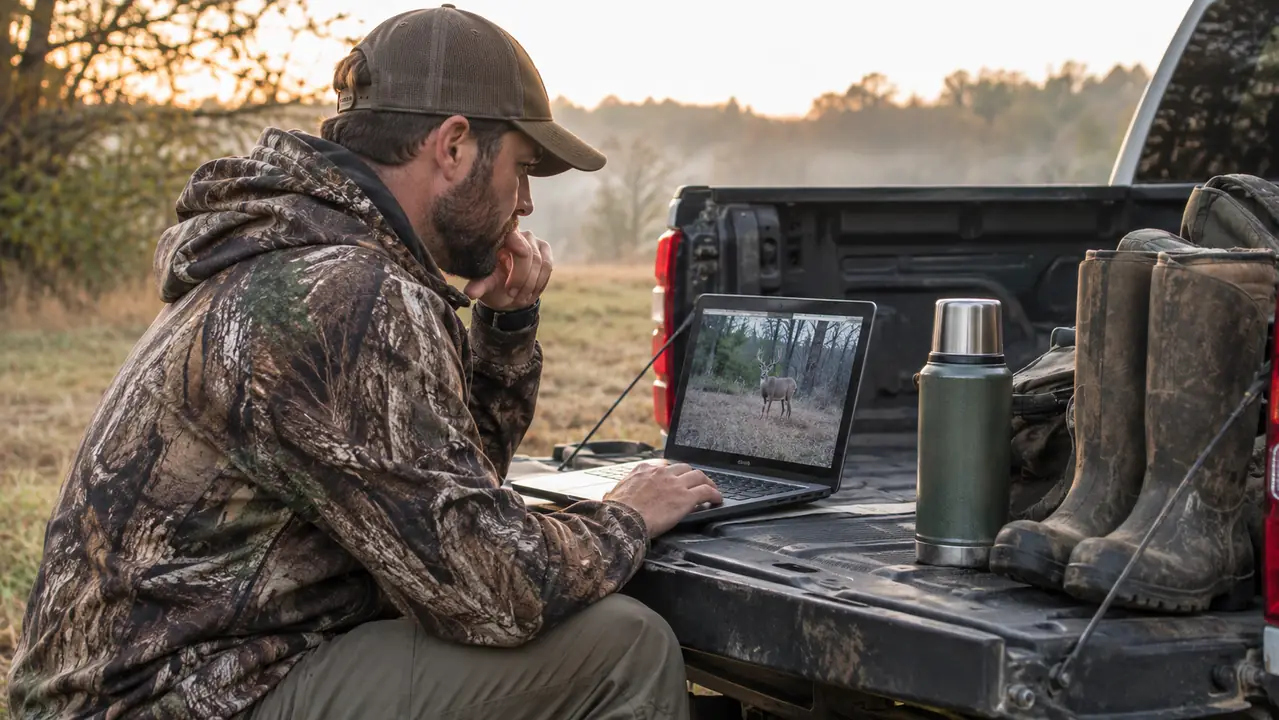
My setup is boring, which is how I like it. I set the WOSPORTS at chest height on a fir trunk, about ten yards off a game trail. I use the tree mount, tighten it down, and angle it slightly downhill because that is where the deer walk. I set the date and time, push the buttons until the menu is where I want it, and close it up. Then I leave. I do not come back for two or three weeks unless I am hunting that draw anyway. When I do come back, I pull the SD card, put it in my laptop that night, and look through the files.
I tried a couple of things before I settled on that. The first was hanging it high, maybe ten feet up, angled down. I figured it would stay out of a person's eyeline and away from a curious cow. What it actually did was fill half the frame with a branch and push every deer down to the bottom edge, small and hard to judge. I moved it to chest height and never went back. The second thing I tried was pointing it straight down the trail. That gets you a picture of a deer's chest from three feet away. Angled twenty degrees across the trail instead, you get the body and the head. That is the setup I run now.
That routine is the reason I still use a camera like this. I do not need a notification at noon. I need to know whether a buck is using the trail in daylight or only after dark. The WOSPORTS gives me that in full-size files. I can zoom in on a rack or a body and make a better call than I can from a thumbnail on a phone. If I get a picture of a shooter at 7:10 in the morning, I can plan the next sit around that. If everything is at 2:00 in the morning, I leave that spot alone for a while.
How the WOSPORTS Handles a Season
The 30MP photos are the part I use most. I am not a photographer. I am a guy trying to tell one buck from another. The higher resolution gives me room to look at antler shape and body size on my laptop. The 1080P video is useful when I want to see how an animal is moving through a gap, not just that it was there. The PIR motion sensor catches movement, and the 850nm infrared night vision lets me see what showed up after legal light. I have had nights where the only action was a doe and two fawns, and I have had nights where a decent buck walked through at 11:40. Either way, I know.
I keep a little log in the truck. Date, time, what walked through, which direction it was headed. Last fall the log told me more than the pictures did. I had four daylight buck photos inside a nine-day window, all between 7:05 and 7:40 in the morning, all on the same trail heading uphill. That is a pattern I can hunt. If I had been checking a phone every day I would have chased every single picture and never noticed the shape of it. Sitting down with the card at the kitchen table once a week is what made it obvious.
The camera is water resistant, so I do not hang it in the wide open. I tuck it under cover and point it out. The ABS body has taken a few bumps against my pack and a couple of falls off a fence post. It still works. The battery power is simple, and I do not have to think about a charging cord in the middle of the season. The one thing I watch is the card. I use a card, pull it, and review it. If I forget to put it back, the camera is just a decoration. That is on me, not the camera.
What a Cellular Camera Buys You
A cellular camera buys you time. That is the product. It takes a picture and sends it while you are doing something else. If you have a farm an hour and a half away, or a piece of ground you can only hunt on weekends, that is a big deal. You can learn a pattern without burning a Saturday. You can also catch a trespasser or a vehicle, which is a different kind of value. The camera is doing the driving for you. You are not.
But you are also signing up for a relationship with a network. You need coverage at the camera. You need a data plan. You need to check the app and keep the account current. If the signal is weak, you get gaps. If the batteries run down, you get nothing. None of that makes cellular cameras bad. It just means they are not free of maintenance. They are a remote tool, and remote tools have remote problems. The WOSPORTS has fewer moving parts because it is not trying to talk to a tower.
Who Should Buy Which
Buy the WOSPORTS if you hunt public land, check your spots on foot, and want full files without a subscription. Buy it if you like pulling a card and sitting at the tailgate with a laptop. Buy it if your ground has spotty cell coverage, or if you do not want one more account in your life. It is also the better pick if you are setting a camera on a travel route and you only need to know what is using it, not what is using it right this minute. For the way I hunt, that is most of the season.
Buy a cellular camera if you live far from your ground, if you cannot get out during the week, or if you need to know what is happening without walking in. Buy it if you are willing to check coverage before you hang it, keep the plan active, and deal with the occasional gap. My son Jake made that trade because his work schedule does not allow him to scout every afternoon. I made the other trade because I am already out there. Neither of us is wrong. We just have different problems to solve.
The best camera is the one you will actually check.
If that means pulling a card on your way out of the timber, the WOSPORTS Mini is built for it. 30MP photos, 1080P video, 850nm infrared night vision, and push-button controls in a compact water resistant body.
Amazon See the WOSPORTS Mini Trail Camera on Amazon →