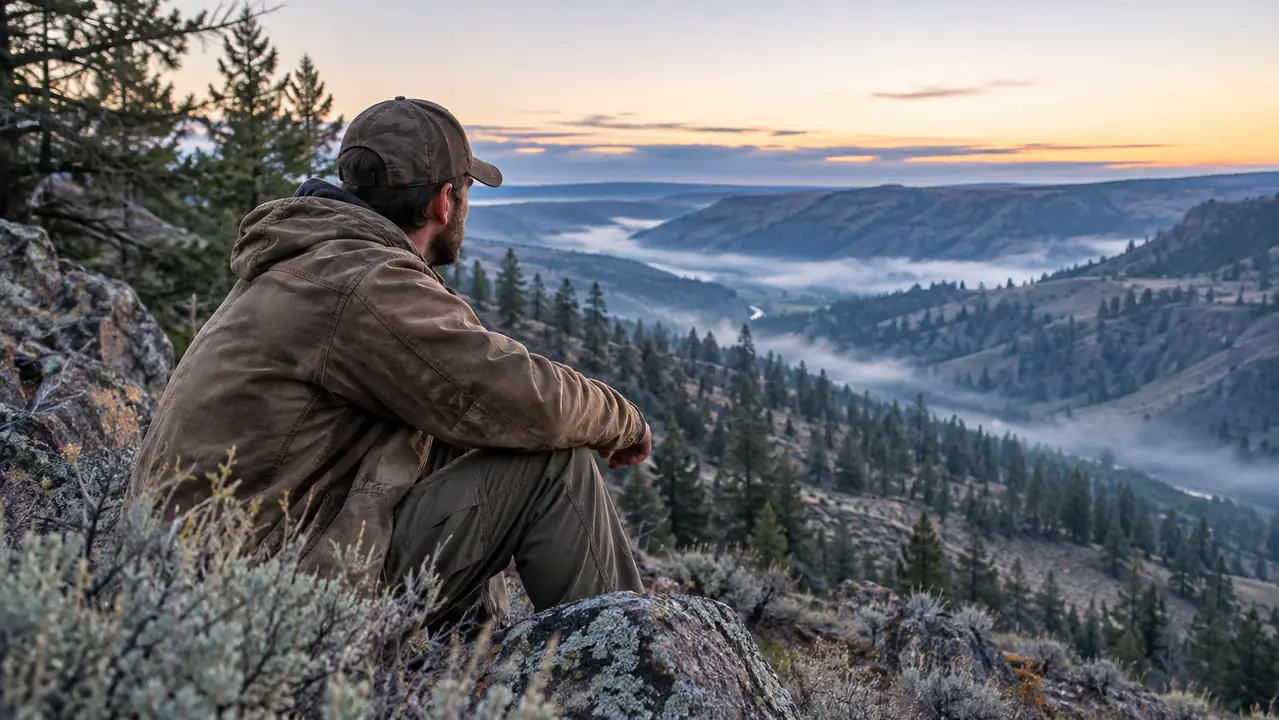
The deer I have killed on public land in eastern Washington, I killed because I saw them before they saw me. That is the whole trick. It has almost nothing to do with a better rifle and everything to do with being able to sit on one ridge for an hour and pick a bedded muley buck out of a hillside that looks, at first glance, like rock and sage and nothing else.
For years I did it the dumb way. I walked, stopped, looked, walked again, and bumped deer out of draws I had no business being in. What changed it was sitting still behind decent glass. Now I carry a pair of Vortex Crossfire HD 10x42 binoculars on a chest harness and I use them until my eyes water. Ten power, 42 millimeter objective, roof prism, 1.4 pounds. Nothing exotic. The glass is not the trick, but the glass has to be good enough that your eyes trust what they are looking at, and these clear that bar.
Ten power, 1.4 pounds, and a warranty that outlasts the truck
The Crossfire HD 10x42 is what actually rides in my pickup from September through November. Fully multi-coated lenses, fog proof, waterproof, rubber armored, eyecups that twist up for bare eyes or glasses, and backed by the Vortex VIP Warranty.
Amazon Check Today's Price on Amazon →Step 1: Get above the ground you plan to glass
Glass from below and you are looking at the underside of the country: shadowed faces, brush, and very little else. Deer bed on benches and shelves where they can put the wind on their face and watch the country below them. To find them, you want to be level with those benches or above them, looking down and across, not up.
In the units I hunt, that usually means a gate, a closed road, and twenty minutes of walking uphill in the dark with a headlamp. It is not fun at 58 and it is not fun carrying a rifle. It is still the highest return on effort in the entire hunt. The difference between looking up a canyon and looking down into one is the difference between seeing a couple of deer in a season and seeing enough of them to be picky about which one you take.
The other half of this is not stopping at the first high spot. The first knob you walk up to almost never sees the best country. Keep going another hundred yards until three drainages open up in front of you instead of one, then sit down. I would rather lose twenty minutes of gray light walking to a good seat than spend a whole morning glassing from a mediocre one and wondering where the deer went.
Step 2: Sit down, brace your elbows, and grid the hillside
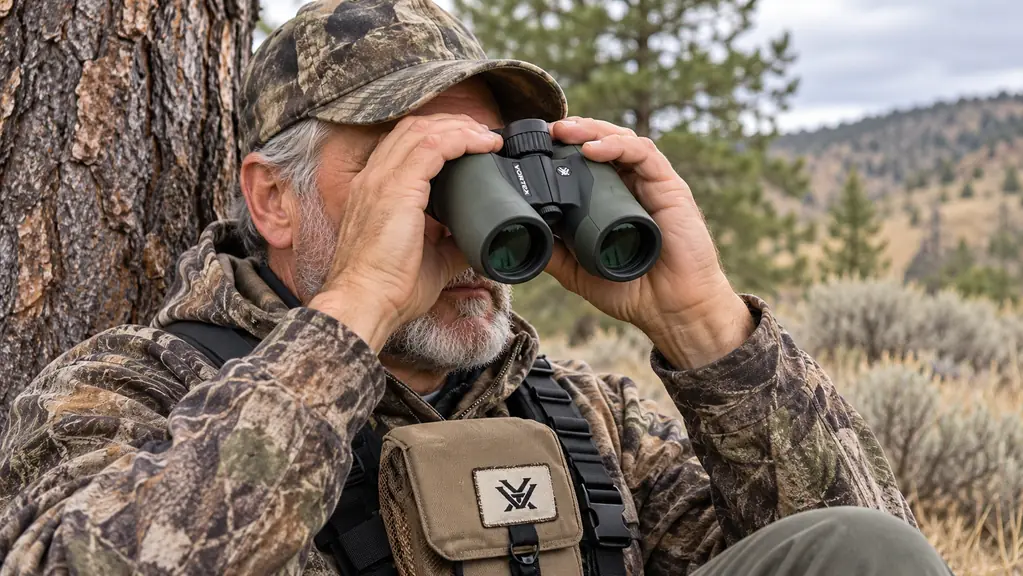
Standing glass is a waste of good light. Your heartbeat alone moves the image enough to hide a bedded deer at 600 yards, and holding ten power out in front of your face is a losing fight after about ninety seconds. Sit with your back against a rock or a pine, put your elbows on your knees, and rest the binoculars on your brow instead of holding them out in the air.
Then work the hillside like a grid. Start at the top left corner, glass across to the right edge, drop down one binocular field, glass back across to the left, and keep going until you run out of hill. It feels mechanical for the first ten minutes. By the second hillside it is automatic, and you start turning up deer in places you would have swept right past an hour earlier.
The method matters more than the magnification. A careful guy with modest glass will find more deer than a guy with expensive glass who sweeps a hillside in big lazy arcs and calls it glassing. Slow is the technique. There is no version of this where fast wins.
Step 3: Set the eyecups and the diopter once, then leave them alone
This is the step people skip and then blame the binoculars for a headache at noon. Twist the eyecups up if you are glassing bare faced and down if you are wearing glasses. Then set the diopter. Close your right eye, focus the left barrel on something sharp with the center wheel, then close your left eye and turn the diopter ring on the right barrel until that side is sharp too. Open both eyes and the image should be one circle, not two.
Once it is right, do not touch it again. The Crossfire HD has 15 millimeters of eye relief, which is enough that I still get the full view with sunglasses on, and the eyecups twist up and stay where I put them. It is fog proof and waterproof, which earns its keep when you go from a warm truck cab into 25 degree air and back again twenty times before lunch.
Every time you pull the caps off and fiddle with the focus you burn a couple of minutes of the best light of the day. On a short November afternoon, a couple of minutes is the difference between a tag punched and a story about the one that got away.
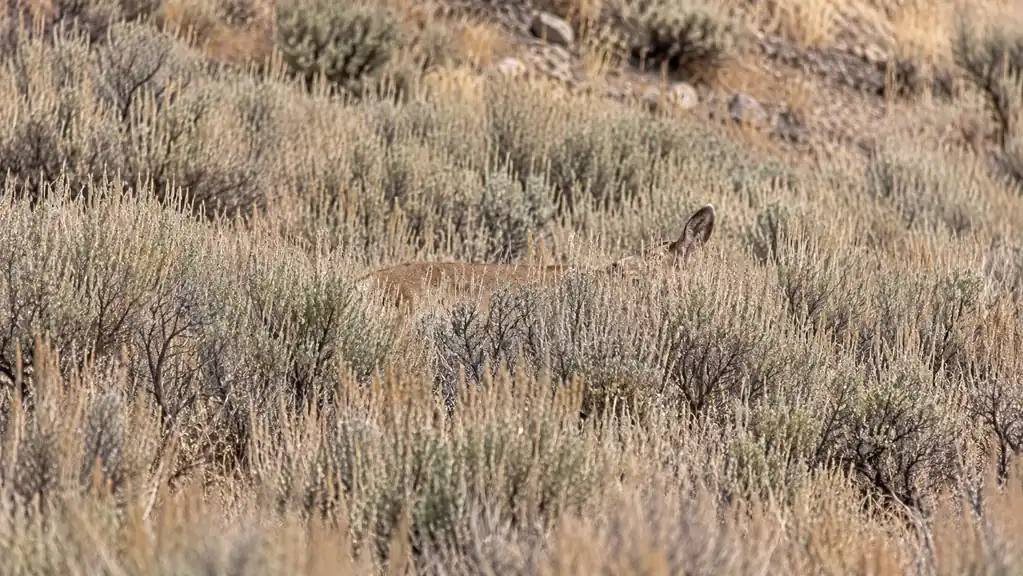
A bedded buck's ear at 500 yards looks like a dry leaf. A dry leaf does not swat at a fly.
Step 4: Look for pieces of a deer, not a whole deer
A bedded buck at 500 yards is not a deer-shaped object. He is a horizontal line, a white rump patch, the inside of an ear, a dark eye in a pale face, or the tip of an antler catching the sun. If you are hunting the picture of a deer standing broadside that lives in your head, you will glass right over ten bedded ones and never know it.
So learn the parts. A straight horizontal back line in a hillside made entirely of vertical sage. A patch of white where nothing else is white. A shape that is a little too round and a little too smooth to be a rock. A shadow that seems to have a shadow of its own. Once you have found a dozen deer this way, your eyes start doing it without being told.
Movement is what gives them up. That is why you glass the same hillside three times instead of once. First pass you see nothing. Second pass a deer turns his head to swat a fly and there he is, plain as day, sitting in a spot your eyes already looked at twice. I have killed more deer off second and third passes than first ones, and it is not close.
Step 5: Work the edges at first and last light
Deer move at the front and the back of the day, and they move along edges. The line where timber meets sage. The lip of a cut bank. The shady side of a draw. That is where I spend my glass time early and late, and it is a different job from midday glassing on a sunny south face.
At first light I am not trying to count points. I am looking for a silhouette against the sky or a horizontal shape crossing a small opening. Low light is where the coatings and the 42 millimeter objective do their real work. Fully multi-coated lenses pass enough light to keep the image usable a few minutes past when my naked eye has given up, and that is usually the exact minute the biggest buck on the hill stands up and stretches.
In the last hour, do something that feels backwards: quit glassing the far hillside and glass the 200 yards around you. Deer that held tight in the timber edge all day will stand and move before dark, and they will do it close. I have had more late-season chances come from turning the binoculars around on my own zip code than from picking apart a mile of country.
What Else Helps
A few things that are not steps, but have made a real difference for me over the years.
A chest harness, first. Binoculars on a neck strap end up under your jacket, fogged up, or swinging into your sternum by hour two. A harness holds them flat against your chest and one hand away, which matters a great deal when a deer stands up without warning and you have about four seconds to get glass on him.
A rest for long sits. Ten power is hand-holdable, but at 800 yards any rest beats no rest. I use a rolled up jacket on a rock more often than anything store bought. If you already carry shooting sticks, they work fine for glassing too, and you are carrying them anyway.
Clean the lenses before the season and then leave them alone. A smeared lens scatters light and makes the whole image look flat, and flat is the last thing you want at gray light. Carry a lens cloth. Do not use your shirttail, and do not wipe grit around in a circle.
Use the glass to check the wind before you commit to a stalk. Thermals run uphill in the morning and downhill in the evening, and you can watch the grass and the tops of the sage bend to confirm which way it is actually moving. It is a small habit that has saved me a lot of blown stalks on deer I had already decided were mine.
Write down where you find deer. I keep a list of six benches in one unit that I check in the same order every fall, and four of them came from writing it down instead of trusting my memory. Hillsides that hold deer in October hold deer in November. The cover changes less than you think it does.
Practice on something you know. Before the season I glass a fence post at a known distance and confirm the focus and the diopter are where I left them. Two minutes in the driveway saves a fumbled minute in the field, and fumbled minutes are the expensive kind.
And the last one, the one that took me the longest to learn: give the glass time. Twenty minutes behind binoculars feels like an hour, and your brain will start telling you there is nothing out there so you can stop. That hour is where the deer are. Vortex builds a binocular that your eyes can stay in that long without strain, and honestly that is most of what I want from glass.
If you are weighing these against a cheaper 10x42, the difference will not show up on a spec sheet. It shows up in the last ten minutes of light and in the third straight day of rain and wet snow. That is also about the point where the VIP Warranty stops being a line on the box and starts being the reason you are not shopping for binoculars again next September.
The glass that lives in my truck from September through November
Vortex Crossfire HD 10x42. Ten power, 42 millimeter objective, fully multi-coated, fog proof, waterproof, 1.4 pounds, and covered by the VIP Warranty. Sit down, brace up, and grid a hillside with it and you will see what I mean.
Amazon Check Today's Price on Amazon →