
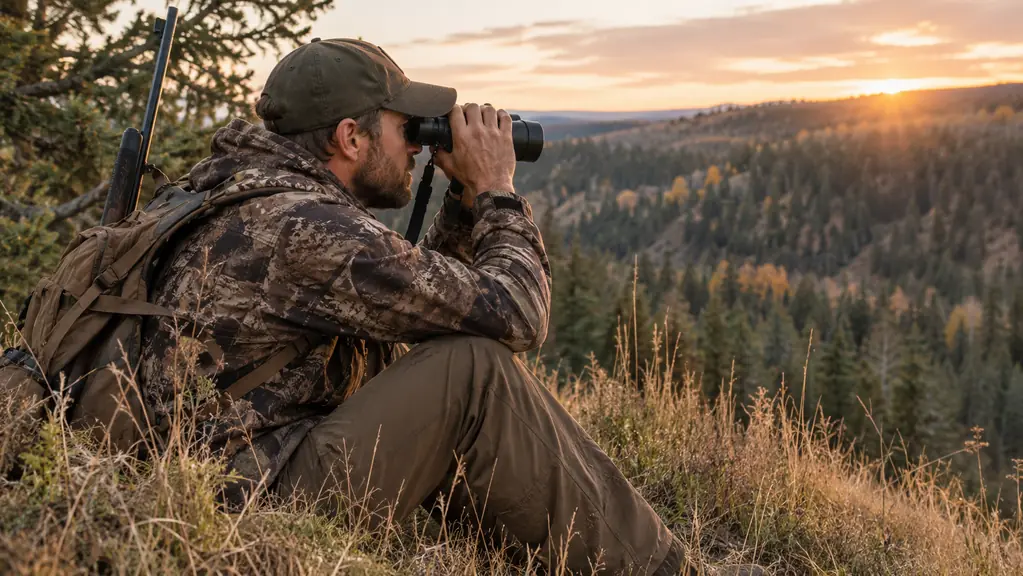
The Vortex Crossfire HD 10x42 is the binocular I spent two seasons talking myself out of. I had a hand-me-down pair that had been dropped in a river twice and still worked, and I could not see spending money on glass when I already owned glass. What changed my mind was a cold November morning on public land in eastern Washington, working a timbered draw for a mule deer buck. Jake spotted him first and started describing the antlers. I could see the deer fine. I could not see the antlers. That settled it in about four seconds, and it is the reason this honest review exists.
So here is what I will not do. I will not tell you these are perfect, because they are not. There are three things about the Crossfire HD I wish somebody had told me before I ordered, and one of those still bothers me in the field. What follows is what I actually found after a fall deer season, a spring turkey season, and a summer of fishing the rivers and lakes north and east of Spokane with these hanging around my neck. Short version is up top if you are in a hurry and the long version is below it.
The Quick Verdict
Honest working glass with a lifetime warranty behind it. The last ten minutes of light are where you feel what you saved.
Amazon Check Today's Price →The Pair That Lives in My Truck Instead of the Safe
Ten power, 42mm objective, waterproof and fog proof, and a warranty that does not run out. Check today's price before your season opens.
Amazon Check Today's Price on Amazon →What Nobody Tells You Before You Buy
First thing: 10x42 is a compromise, and it helps to know which side of it you are buying. Ten power is the standard for a reason. It turns a deer at 300 yards into something you can actually judge instead of something you guess at. The 42mm objective is the other half of that deal. It gathers enough light to work through legal shooting hours in most conditions. It does not make the last five minutes of the day look like noon. The spec sheet lists a 4.2 millimeter exit pupil and a relative brightness of 17.64, and those two numbers tell you more honestly what you are getting than any ad copy will.
Second thing: 15 millimeters of eye relief is a real number and not a marketing one. I wear glasses and I keep them on in the field, and 15mm works, but just barely. The eyecups twist up and down, and with the cups down and my glasses on I get the full field without hunting for it. Carol does not wear glasses and she runs the cups up and gets a comfortable view. If you have deep-set eyes or thick frames, get your eyes behind a pair before you order. That is not a knock on the glass, it is the one line on the spec sheet you cannot read your way to.
Third thing: weight. The listed weight is 1.4 pounds. On the kitchen scale that is nothing. Around your neck for four hours, up and down, up and down, it turns into something. I moved to a harness after the second weekend of the season and I have not gone back. The rubber armor earns its keep here, because it gives you something to hold onto when your hands are cold and wet, and it has taken a couple of knocks against a truck box and one against rock without showing anything I care about.
And the thing that still bugs me after a full season: the focus wheel takes more turn than I want to move from a treeline at 60 yards to a ridge at 400. It is smooth. It is not stiff or gritty. It is just geared a touch slow for the way I glass, which is range, look, range, look. If you sit and watch one draw for an hour, you will never think about it. If you work open country and swap distances all day long, you will think about it every hour.
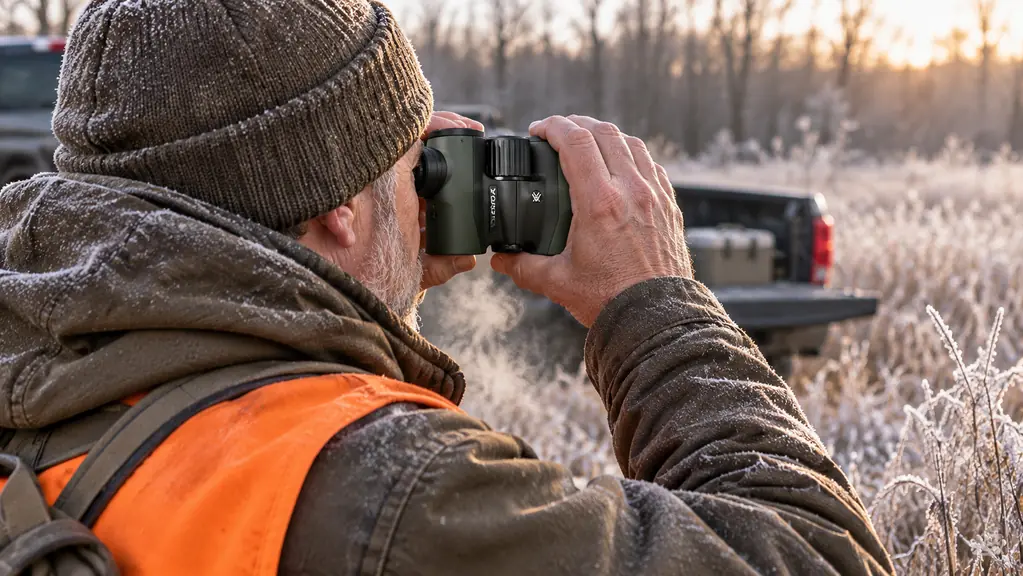
How I've Actually Used Them
Deer season is where these earned their spot. Eastern Washington public land is timber and steep open faces, and most of my glassing is done sitting down with my elbows braced on my knees, working a hillside in sections. Ten power is right for that. It is enough to pick a horizontal line out of a brushy slope at 400 yards, and not so much that the image comes apart when you are still breathing hard from the climb. I have turned up two does and a spike in cover where I would have walked right past with the old glass, and one of those does filled the tag.
Spring turkey is a different job and it showed me a limit. Turkeys are close range most of the time. When a bird hangs up in the sage at 60 yards, ten power is too much binocular and you end up hunting for him inside the glass instead of watching him. I still carry them, because picking the far edge of a field apart before first light is worth the weight, but I leave them in the truck when I am working tight cover. That is not a defect. It is a mismatch between the tool and the job, and it is worth knowing before you buy.
Fishing is where I expected them to be dead weight and where they surprised me. From the bank on a trout river they mostly ride in the pack. From the boat on a lake they are genuinely useful. I use them to read the far shoreline for rising fish, to look over the structure along a point before I commit to fishing it, and to see whether anybody else is netting anything. Sitting in a 14 foot aluminum boat with my elbows on my knees, they are steady enough to be worth having. Carol uses them to watch ospreys, which is not what I bought them for, but it counts.
One more thing about how I carry them. They live in the truck, and they come out at every stop where there is something worth looking at. That sounds like a small habit, but it is the difference between a binocular you own and a binocular you use. The pair I had before lived in a case in the closet because I was scared of breaking it. These live on the seat, and they have been better off for it.
I could see the deer fine. I could not see the antlers. That settled the whole argument.
Where the Glass Falls Short
Every binocular in this class has an edge, and these are no exception. The center of the image is sharp and the color is honest. Toward the outer third of the field things soften, and on a hard high contrast line, like a dark roofline against a bright sky, you can find some color fringing if you go hunting for it. I do not see it when I am glassing a deer. I see it when I am standing in a driveway testing binoculars, which is not how I use binoculars.
The low light question is the one I get asked most, so here it is plainly. At first and last light the image goes grainy before the deer get hard to see. There is a window of maybe ten to fifteen minutes at each end of the day where more expensive glass is still showing detail and these are showing you a suggestion. I have never lost an animal because of it. I have lost some confidence because of it, on evenings when a shape in the timber could have been a stump or could have been a buck. That is the honest trade, and it is the reason these are not the last pair you will ever buy.
Waterproof and fog proof both held up. These have been rained on, snowed on, and left in a cold truck overnight and then carried into a warm cab, which is the classic way to fog a binocular. They did not fog. I have not put them in a river, but I have knocked them off a tailgate onto gravel, and the armor did its job. The eyecups have not loosened, the hinge has not gone floppy, and the focus wheel feels the same as the day I took them out of the box.
What Surprised Me After a Season
The thing that surprised me most is how little fiddling they need. I set them once, the first week, and I have not had to touch the eyecups since. They come up to my eyes and the view is full and round with no black crescents, which sounds like a small thing until you have used a pair where it is not true. Cold weather did not change that. Neither did the wet.
The other surprise is how often I reach for them when I am not hunting. Glassing a far bank. Checking whether that is a boat or a log. Watching a hawk work a field. A pair of binoculars that lives in the truck gets used forty times more than a pair that lives in a case in the closet, and these have made themselves at home in the truck. That is the highest compliment I can pay a piece of gear.
What I'd Change If I Could
Two changes and I would stop looking at other binoculars. First, I would gear the focus wheel a little faster, because the distance swing I make all day is the one thing that never stops feeling slow. Second, I would push the eye relief past 15 millimeters so the guys with thick glasses get some margin instead of landing right on the edge of it. Neither of those is a deal breaker. Both are the kind of thing you notice more each season, not less.
What I would not change: the armor, the eyecups, the warranty, or the size. A 42mm objective is the right size for a truck binocular. It fits in the door pocket, it comes up fast, and it does not turn into a scope you leave at home because it is a hassle to carry. Bigger glass shows you more. It also stays in the truck more, and a binocular in the truck is worth three in the closet.
How They Compare to the Glass I've Owned
I have owned three pairs of binoculars in my life. The first was a cheap pair from a department store that never did stay in focus. The second was the hand-me-down pair that survived two dunks in a river and taught me that a roof prism binocular will take more abuse than you think. These are the third, and they are the first pair where I stopped thinking about the binoculars and started thinking about what I was looking at. That is the whole job, and it took me three pairs to get there.
I have looked through friends' more expensive glass and I can see where the money goes. The view at last light is brighter and the edges are cleaner. I have not looked through anything in this price range that beat these, and I have looked through a few that cost more and did not clearly beat them either. Take that for what it is worth from a guy who has not tested them side by side on a bench.
The Warranty Is the Real Story
I would be doing you a disservice if I did not spend a minute on the warranty, because it changes the arithmetic on a binocular in this class. Vortex backs the Crossfire HD with an unlimited, unconditional, lifetime VIP warranty. It transfers if you sell the binocular. It does not care whether the damage was their fault or yours. I have not had to use it. Two people I hunt with have used it on other Vortex products, and both came back repaired or replaced without an argument. That is worth real money on a rocky hillside where a fall is a question of when and not if.
That warranty also changed how I treat them. When a company tells you they will fix it no matter what happened, you stop treating the binocular like an heirloom and start treating it like a tool. That is the right relationship to have with something that rides in a truck and gets rained on. I have quit babying these, and they have held up better for it.
What I Liked
- Center image is sharp enough to judge antlers at 300 yards
- Waterproof and fog proof both held through a wet, cold fall
- Unlimited, unconditional, lifetime VIP warranty that transfers if you sell
- Rubber armor takes gravel, tailgates and truck box knocks
- Twist-up eyecups work with glasses, though just barely
Where It Falls Short
- Last light goes grainy sooner than premium glass does
- Focus wheel is geared slower than open-country glassing wants
- 1.4 pounds gets heavy on a neck strap after a few hours
- Edge softness and some color fringing on hard high contrast lines
Who This Is For
This is for the hunter who walks in from the truck, sits down, and glasses a hillside for an hour at a time. It is for the angler who wants to read a far shoreline without spending boat money on glass. It is for anybody who wants one pair of binoculars that will do deer, turkey, and a day on the lake, and who would rather spend the difference on gas and tags. If you are hard on gear and you want to stop worrying about it, the warranty alone makes these worth a hard look.
Who Should Skip It
Skip these if your glassing happens in the last ten minutes of light and that is the whole point of your season. Skip them if you spend your falls in wide open country where you range all day, because the focus wheel will wear on you. Skip them if you have deep-set eyes and thick glasses and you cannot get behind a pair first. And skip them if you are the kind of person who will always wonder about the next tier up, because you will wonder with these too. They are good. They are not the end of the road.
One Pair That Does Deer, Turkey, and a Morning on the Lake
Waterproof, fog proof, and covered by a lifetime warranty that does not ask how it broke. Check today's price and get them before opening day.
Amazon See Current Price on Amazon →